Monday, January 14, 2008

Hello Mercury!!


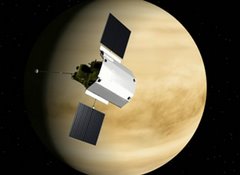
The MESSENGER spacecraft will make its first flyby of Mercury today at 2:04:39 pm EST!! This image of Mercury was taken yesterday on January 13 when the spacecraft was at a distance of about 760,000 kilometers (470,000 miles) from Mercury. Mercury is about 4880 kilometers (about 3030 miles) in diameter, and the smallest feature visible in this image is about 20 kilometers (12 miles) across.

During the historic encounter today, extensive scientific data will be gathered. The Mercury Dual Imaging System cameras will acquire more than 1,200 images of Mercury, including images of portions of the surface never before viewed by a spacecraft. The Mercury Atmospheric and Surface Composition Spectrometer will observe Mercury's surface as well as its tenuous atmosphere. The Magnetometer will accurately measure Mercury's magnetic field, and the Energetic Particle and Plasma Spectrometer will characterize Mercury's space environment and interactions with the solar wind. The Mercury Laser Altimeter will sense surface topography along a narrow profile. The Gamma-Ray and Neutron Spectrometer and X-Ray Spectrometer will make the first measurements of Mercury’s surface elemental composition.


MESSENGER will begin to transmit the new data to Earth once all of the scientific measurements are completed, about 22 hours after the spacecraft's closest approach to Mercury. These flyby data will shed light on fundamental scientific questions related to the formation and evolution of the planet Mercury. As scientists analyze the data, the MESSENGER spacecraft will continue on its planned journey, which includes two more encounters of Mercury in October 2008 and September 2009, before entering an orbit around Mercury in March 2011.

Additional information and features from this first flyby will be available online at http://messenger.jhuapl.edu/mer_flyby1.html, so check back frequently. Following the flyby, be sure to check for the latest released images and science results!

Wednesday, January 9, 2008

Mercury Here We Come!!

This Monday, January 14, 2008, the MESSENGER spacecraft will make its first flyby of Mercury! Monday's flyby, which is taking place more than three decades after the last spacecraft visit of Mercury (Mariner 10), will take MESSENGER to about 200 kilometers above Mercury's surface. To learn more about the flyby, click here. The following movie features Sean C. Solomon, Principal Investigator for the MESSENGER mission.


Wednesday, January 2, 2008

Happy New Year!!


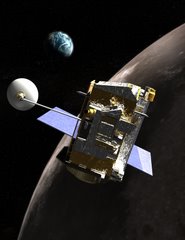
2008 will be a very exciting year for us with the MESSENGER flyby of Mercury in a couple weeks on Jan. 14 and the launch of the Lunar Reconnaissance Orbiter (LRO) on Oct. 31!

To learn more about the Mercury flyby, including how you can celebrate the event with others if you live in the DC/Baltimore area, click
here.

To read the recently released LRO fact sheet, click
here.

Friday, December 14, 2007

NASA CoLab


This week, I had the opportunity to meet two gentleman (one of whom I already had met in my second life - more on this in a minute) from
NASA CoLab. CoLab supports on- and off-line collaboration between the various NASA Centers and between NASA and the public. To this end, they have established a presence in both real life (in San Francisco) and in Second Life.

Second Life
(SL) is a 3D Multi-User Virtual Environment (MUVE) in which avatars (a virtual representation of one’s self) interact via communicating, learning, exploring, playing, and conducting business together. It currently has over 11,240,207 registered members, which it terms “residents,” from over 100 different countries.

What makes SL so attractive to its residents is that it is completely imagined and created by them. This means it is self-evolving, such that each time a resident logs in they may find that their surroundings have changed or that new places, objects, and people exist where before there were none. In addition, avatars are fully customizable, such that residents may change their basic appearance (e.g. hair color, eye color, etc.), race, gender, clothing, and even mannerisms and gestures at any time. While some residents choose to represent themselves in a manner similar to their real life (RL) self, others choose to represent themselves as animals, mythical creatures, robots, or combinations thereof.

In addition to individuals, residents of SL include many RL groups, including federal agencies (e.g. NASA and NOAA), universities, museums, planetariums, businesses, nonprofits, embassies, and the tourism departments of many countries. These groups are using SL to communicate with and educate the general public. To learn more and to download the Second Life platform, which is free, visit http://www.secondlife.com.

Ready to visit NASA CoLab in Second Life? Click here.