Friday, December 7, 2007

Returning to the Moon


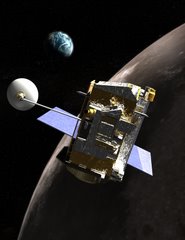
The LRO website has a new video available: Return with LRO. “The Deputy Project Manager for the Lunar Reconnaissance Orbiter (LRO) program, Cathy Peddie, expresses her personal and professional thoughts on the upcoming LRO mission. From following in the footsteps of her childhood heroes, to building, testing, and intergrading the LRO instruments, to how LRO may play into future missions.” Check out the video at: http://learners.gsfc.nasa.gov/mediaviewer/LRO/

Wednesday, December 5, 2007

Update on MESSENGER mission to Mercury


On Friday, November 30, the MESSENGER team resumed daily contact with its Mercury-bound spacecraft. Engineers had suspended contact on November 13 when the spacecraft’s trajectory moved it to the opposite side of the Sun from Earth and out of radio contact with NASA’s Deep Space Network for several weeks. Read the complete story here.

As of right now, there are 36 days, 22 hours, 24 minutes, and 57 seconds until MESSENGER's first flyby of Mercury on January 14, 2008! View the countdown clock at http://messenger.jhuapl.edu/.

Monday, December 3, 2007

'Tis the Season for Candy and Mars Exploration


Now that the candy and sweets season is in full swing, why not put some of that sugary goodness to good use to learn about Mars exploration?

"Areology - The Study of Mars"
Using candy bars, plastic straws, and a few other simple items, students will accomplish these objectives:
· Examine a simulated Martian surface core sample.
· Learn how an unknown core sample can be identified by matching it with a known sample.
· Discover how surface core samples can tell us about the history and make-up of Mars.
· Consume the core sample at the end of the exercise!

View the complete activity, other Mars activities, and an associated teacher guide in the Mars Acitivities book at http://mars.jpl.nasa.gov/classroom/pdfs/MSIP-MarsActivities.pdf.


Friday, November 30, 2007

The 2007 Antarctic Ozone Hole


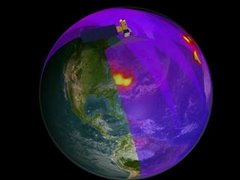
The Ozone Monitoring Instrument (OMI) aboard NASA's Aura spacecraft is able to "see" the "hole" that develops in the ozone layer above Antarctica every winter. What is known as a "hole" in the ozone layer (the layer of concentrated ozone that resides in the stratosphere) is actually a thinning or depletion of ozone concentrations in the stratosphere. Due to a complex series of physical and chemical reactions in the atmosphere, this thinning happens every winter in the southern hemisphere. As summer approaches in Antarctica, the ozone hole disappears, and normal ozone levels return. As Aura orbits the Earth, the data OMI takes enables scientists to study this chemical cycle. You can view a movie of the 2007 ozone hole from the Ozone Watch website:

http://ozonewatch.gsfc.nasa.gov/ozone_maps/movies/OZONE_D2007-07-01%25P1D_G%5e720X486.LSH.mpg