Tuesday, April 15, 2008

Volcanoes + Satellites = Awesomeness

There are days when I want to run through the halls of my office screaming like a banshee because I'm so frustrated with people (who think they know what we do but haven't the first incling) who make our work lives a living nightmare. 1.

Then there are days where I'm reminded of how much I love what I do, and how cool and very utterly exciting all of it is.

Today started like that first description. Scratch that - the past week has been like that first description. As I sat down to write this blog entry, however, today became one of those days that's like the second description. I was instantly reminded of why I got into this buisness in the first place:

Science + New ways to view the world = Awesomeness

The variables in the above equation can be substituted with just about any kind of scientific pursuit, such as it is in the title of this blog entry.

2.

What in the world am I talking about, you might ask? It's simple. Take one constantly erupting volcano, add in some high-tech observations from 705 km (438 miles) above the Earth, and presto! Instant awesomeness.

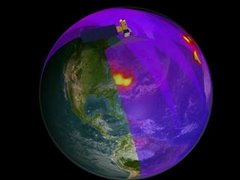
Kilauea volcano has been making the news rounds lately because it started erupting from the main caldera in March. (You can find out information about the eruption here). According to the Associated Press, prior to the March eruptions, Kilauea's caldera hadn't erupted since 1924. Back then, the best scientific data we could get about volcanic gases came from a view rare souls who were brave enough to get as close as they dared. Flash forward to the present. Now, the Ozone Monitoring Instrument (OMI) aboard the Aura spacecraft has been taking daily data on the SO2 emissions from Halema 'uma 'u vent. These data show the enormous amout of SO2 that is spewing from the vent, and give us that information on a daily basis.

Like I said, one of the reasons why I love what I do.


The images on this page show 1. Kilauea from the ground and from 2. Aura's OMI instrument.


Related links:
Kilauea volcano
OMI SO2 measurements
Earth Observatory article on OMI SO2 and Kilauea

Thursday, April 3, 2008

Party at Yuri's Night DC - April 12, 2008

Yuri's Night is almost here! Yuri's Night is an annual, worldwide event to celebrate manned spaceflight. On April 12, 1961, Russian Cosmonaut Yuri Gagarin became the first man to travel into space. Twenty years later, on April 12, 1981, the US launched the first space shuttle mission. Yuri's Night is celebrated all over the world - last year events were held in over 30 countries! If you live in the DC, MD, VA area you can celebrate Yuri's Night 2008 at NASA's Goddard Space Flight Center in Greenbelt, MD, on April 12. According to the website, you'll be able to... "Groove to live music from the popular local band, the Cassettes or DJ Scientifics' hip hop infused beats. Jump in our Moon Bounce. Kick back with a NASA rocket scientist. Climb in a Mercury Capsule. Check out the ultimate disco ball, the Science on a Sphere Exhibit. Chill out in the glow of extrasolar planets." There will also be contests and give-aways! The party will run from 7pm-1am. Shuttle service will be available between Goddard and the Greenbelt Metro Station.

Check out the Yuri's Night 2008 website for more information on festivities, tickets, directions, etc. Hope to see you all there!

Thursday, March 20, 2008

Back in MD after a successful and interesting LPSC

Last week Steph and I attended the Lunar and Planetary Science Conference in TX. We had a great time, caught up with old friends, met new ones, and learned a lot. The two education workshops, one on the Moon and one on Mercury and Pluto, went well. Our poster presentation on Tuesday night was also a hit. We had tons of people stop by from various NASA centers and missions, universities, and even the European Space Agency (ESA). While most of the visitors to our poster had heard of Second Life before, not many of them had ever tried it out. All were surprised to learn about all of the space-and science-related activities already occurring there and were very intrigued by our suggestions for how it could be used for participatory exploration.

For a great account of the week's events and some of the major scientific presentations from LPSC, visit this Nature reporter's blog.

Friday, March 7, 2008

39th Lunar and Planetary Science Conference


Geosteph and I are leaving this weekend to travel to TX for the 39th Lunar and Planetary Science Conference. It's a week-long conference for international planetary scientists and educators to present their current research and mission results. The conference consists of both talks and poster presentations on a variety of subjects. View the enitre program, which includes links to the abstracts.

On Sunday, Geosteph will help lead a workshop called Reaching the Moon for planetary scientists and educators. Then on Wednesday we'll both lead a workshop for educators called Fire and Ice about the MESSENGER mission to Mercury and the New Horizons mission to Pluto. There may still be slots available for these workshops. Click here to learn more.

On Tuesday, we will be presenting a poster on Tuesday night in the Education and Public Outreach Programs session to accompany our abstract, which is about how NASA might use Second Life for informal space science education and participatory exploration.

If we're lucky, Geosteph might tweet from the meeting so stay tuned!