Wednesday, November 7, 2007

Making Our Way to Mercury Again...


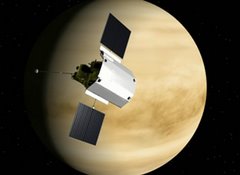
MESSENGER (MErcury Surface, Space ENvironment, GEochemistry, and Ranging), launched August 3, 2004, is NASA's first mission back to Mercury in over 30 years. The first mission to visit Mercury was Mariner 10. It flew by the planet three times between 1974 & 1975. During that time, it only imaged about 45% of Mercury.

Unlike Mariner 10, MESSENGER is designed to orbit Mercury. But, in order to get there, MESSENGER will make one flyby of the Earth, two flybys of Venus, and three flybys of Mercury. During MESSENGER's three flybys of Mercury, it will have imaged the whole planet. The first of the three flybys will take play on January 14, 2008. It won't be until March 2011 when MESSENGER will enter into an orbit around Mercury.

Once in orbit, MESSENGER will begin to gather data to better understand Mercury and how the other planets formed. Scientist hope to answer the following six questions:
  1. Why is Mercury so dense?
  2. What is the geologic history of Mercury?
  3. What is the nature of Mercury's magnetic field?
  4. What is the structure of Mercury's core?
  5. What are the unusual materials at Mercury's poles?
  6. What volatiles are important at Mercury?
For more information on MESSENGER, please visit: http://messenger.jhuapl.edu/
Stay tuned for future blogs on MESSENGER.

Monday, November 5, 2007

NASA and AIAA Student Podcast Competition


"What do you think is NASA's greatest exploration achievement in the past 50 years and why?"

Exploration provides the foundation of our knowledge, technology, resources, and inspiration. It seeks answers to the fundamental questions about our experience, responds to recent discoveries and puts in place revolutionary technologies and capabilities to inspire our nation, the world, and the next generation. Through NASA and its partners, we touch the unknown, we learn and we understand. As we take our first steps toward sustaining a human presence in the solar system, we can look forward to far off visions becoming realities of the future. The 21st Century Explorer Podcast Competition is an Education and Public Outreach project designed to inspire and motivate the next generation of explorers and to compete effectively for the minds, imaginations, and career ambitions of America's young people. Students will create an audio recording or video short to answer the question: "What do you think is NASA's greatest exploration achievement in the past 50 years and why?"
The contest starts on OCTOBER 1, 2007 AT 12:00 AM ET. Competition closes with the first 1,000 entries in each category or until midnight on JANUARY 4, 2008 ET, whichever comes first.

Division 1
Audio Podcast – Age Group (11-14)
Video Podcast – Age Group (11-14)

Division 2
Audio Podcast - Age Group (15-18)
Video Podcast – Age Group (15-18)

All entries must meet the following minimum requirements:

  • Each contestant must be a United States citizen between 11-18 years of age.
  • Each contestant must submit an entry form.
  • Parents must consent if entrant is under the age of 18.
  • Entry must meet technical specifications (see right).
  • Any use of copyrighted material will disqualify entry.
  • Only one (1) entry per person.
Judging Criteria
A panel of judges will choose 15 finalists per each of the two areas (audio and video) and per each age group. Finalists will be displayed on the website between February 14th and February 14th and February 28th, 2008. First, Second, and Third Place winners will be selected from the fifteen (15) finalists in each category. Judges for the Final Round will be comprised of attendees at the Third Space Exploration Conference to be held in Denver, CO on February 26-28, 2008. The contest winners will be announced on the website on February 28, 2008.

Judging will be based on 5 point scale based on the following criteria:
  • Content: Is the treatment of the subject matter effective? (i.e. storytelling, script, etc.)
  • Creativity: Do the production elements add to the program? (i.e. graphics, SFX, or camera talent, design, animation, etc.)
  • Execution: Were technical levels maintained? (clarity, levels, distortion, etc.)
  • Clarity: Was the contestant able to communicate their idea effectively? (objectives, story flow, interest, etc.)
  • Summation: What was the overall impression?
Contestants will be able to receive a maximum of 25 points, which is based upon the contest’s criteria, is a perfect score.

Additionally, during the period of February 14th through February 28th, 2008, the public will vote for and select a “People’s Choice” winner.


More information go to www.explorationpodcast.com

Wednesday, October 24, 2007

ASTC Day 5 - The last one!

My last day at the ASTC meeting was short...

Tuesday, October 16, 2007:

Web 2.0 session

After checking out of the hotel this morning, I made my way over to the convention center for one last session on how museums are embracing Web 2.0. First up was someone from the
Ontario Science Centre. He gave an overview of common social media Websites, which are sites where users publish the content and have the choice of interacting with each other, and some statistics to go with it: ~96% of 9-17 year olds and ~75% of 18-35 year olds use social media sites. Obviously museums and other educational entities need to embrace social media if they want to reach these age groups to the fullest extent possible. Examples of social media sites include MySpace, Facebook, YouTube, Flickr, Twitter, Wikipedia, blogs, etc. Of course, if you're reading this blog you're probably already familiar with most if not all of these! One that I learned about from this presenter is Instructables, a site in which users "share what they do and how they do it, and learn from and collaborate with others". Ever wanted to attach a sink to the top of your toilet? If so, you can learn how to do it and LOTS of other random things here.

In any case, some museums are starting to embrace and use social media to both their advantage and that of their real life and virtual visitors. For example some museums are using Facebook and MySpace to communicate with visitors and keep them updated as to events and openings. This is also a good way for museums to get feedback and to reach people that they may not have otherwise. For example, if one of your friends on MySpace lists a museum or science center as one of their friends, you might be inclined to click on that museum's MySpace page and see what's going on. Other museums are using Twitter, a site in which people all over the world simply answer the question "What are you doing right now?", to give people a glimpse of what goes on behind the scenes in their museum. The writer of the Museum 2.0 blog (who was one of the presenters in this session - see below) provides examples of how and why museums are using some of these sites and others with more detail and eloquence than I have time for here. Read her posts on Twitter and blogs.

The second presenter was from the Science Museum of Minnesota which actually has its own blog on how museums use technology and the Web. He gave more examples of how museums are using Web 2.0, such as his museum's ScienceBuzz, which I discussed in a previous post.

The third presenter was from www.museumblogs.org, which is a blog that tracks other museum-related blogs. He said that of the museums that blog, ~60% publish fewer than 5 times per month (as of Jan. 2007). In order for a museum's blog to be successful, it must "publish or perish!!" Science museums make up only ~15% of museum blogs. I wonder why?

The last presenter was from the Museum 2.0 blog that I mentioned above and in an earlier post. She spoke mostly about museums in Second Life. Successful museums within Second Life are those that offer extensive programming and opportunities for social interaction in addition to great exhibits and builds. An example is the International Spaceflight Museum, which actually not does not have a real life counterpart. In addition to a fantastic rocket garden, a solar system exhibit that you access via a rocket ride into low Earth orbit, and other great exhibits, it also offers a weekly jazz concert on Thursday nights. Even though one can argue that the concert is not educational in nature, it provides an opportunity for people to interact in the museum setting, which can lead to discussions about the museum and its content, other related topics, etc.

In addition to museums, NASA and other federal agencies, such as NOAA, are building and interacting with the public in Second Life. For more information on their activities click here: NASA, NOAA. For those of you that already have a Second Life account (which is FREE by the way) and wish to visit their builds directly, click here: NASA, NOAA. I'll write more on NASA in Second Life at another time.

Tuesday, October 23, 2007

ASTC Day 4

Almost done... Here's the rundown from Day 4 of the ASTC meeting in CA.

Monday, October 15, 2007

Field Trip to Griffith Observatory
This morning I boarded a bus along with 250 of my closest friends to travel to Griffith Observatory in LA's Griffith Park. The drive took us up a winding road in the Park. Unfortunately it was cloudy and drizzling for most of the day, so what would normally have been a fabulous view was obscured by clouds. The Observatory is absolutely gorgeous (although I read somewhere once that it is also called "the hood ornament of Los Angeles"). It opened in 1935 and was the country's premier site for public telescope viewing. It closed its doors in 2002 for a $93 million renovation and expansion. The doors reopened in late 2006. Because public interest in viewing the renovations is so high at present, visits to the Griffith are by appointment only until demand decreases.

The Griffith has several exhibit galleries. The one I enjoyed the most was its "Hall of the Sky" in which models of the Sun, Earth, and Moon were used in combination with animations and text panels to illustrate basic astronomy phenomena such as eclipses, seasons, moon phases, etc. Using this three-pronged approach helps the exhibits appeal to a wide audience with different learning styles, ages, and levels of familiarity with the subject matter. I also really enjoyed viewing the various meteorites on display, especially one of the Los Angeles shergottites
(a shergottite is a type of martian meteorite). Since we have not yet been able to return samples from Mars, martian meteorites are the only samples of the Red Planet available for scientific analysis. However, NASA is planning a Mars sample return mission for the future so stay tuned.

After touring the exhibits I had a chance to view clips of recently developed planetarium shows, data visualizations, and experimental music and art (kind of like the Pink Floyd laser shows you might be familiar with but with better graphics) in the Griffith Observatory's Samuel Oschin Planetarium. The Planetarium has a new star projector and a new digital projection system. Some of the NASA collaborations we got to view were "The Search for Life: Are we Alone?", "Passport to the Universe", and "Cosmic Collisions". These shows are traveling the country so be sure to check the listings at your local planetarium in case you're interested.

Back at the California Science Center
Later in the day I was back at the California Science Center where I toured more of the exhibits. My favorite was "Goose Bumps! The Science of Fear". In addition to learning about how and why we physically react to fearful situations, the exhibit contains a challenge course in which you can test your ability to overcome certain fears (like falling or touching insects and snakes) and then analyze your physical reactions. One of the cool things about this exhibit is that visitors actually become part of it because it's set up in such a way that you can observe each other's reactions during the challenge course. The exhibit will be leaving the CSS in December to go on tour around the US so be sure to check it out when it comes to your area!

And in case you're wondering, I was too chicken to do the part of the challenge course that involved touching hissing cockroaches. One thing I'm not afraid of is admitting that I'm afraid!

"Fly Me to the Moon"
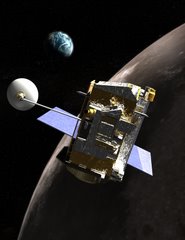
After having a popsicle (aka margarita) in the Rose Garden of Exposition Park, I watched a screening of "Fly Me to the Moon" in the CSS IMAX theater. "Fly Me to the Moon" is a new 3D movie about 3 flies that travel to the Moon along with the Apollo 11 astronauts. It's scheduled for release in 2008. The 3D animations were great. Hopefully this movie will help get kids interested in not only the Apollo missions, but in NASA's upcoming efforts to return humans to the Moon and then eventually send them to Mars. The first step in this "Vision for Space Exploration" is the Lunar Reconnaissance Orbiter, which will launch late next year!!