Friday, February 15, 2008

The Other Side of the Moon: Synchronous Rotation lesson


Have you ever wondered why we only see one side of the Moon? Well, the reason why we never get a shot of the far side of the moon is because the Moon is in what we call a "synchronous rotation" with the Earth. That is, it takes the Moon the same amount of time to rotate on its axis (or one lunar day) as it does to make one orbit around the Earth. The lesson highlighted in this entry was written by the Cassini team to explain how moons move in synchronous orbits.

Grades 5-8
Time required: 1 hour

Materials
Desk chair that rotates
Rubber, styrofoam, or tennis ball
Pencil or long dowel
Marking pen
Desk lamp or overhead projector
Optional: strong adhesive tape

Procedure:

Stick the pencil or dowel (for use as a handle) through the ball along a diameter; this simulates the Moon. With the marking pen, write a large letter or number every 90 degrees around the circumference of the ball. The handle will either be held at arm’s length by a student sitting in the chair or it can be taped to the armrest of the chair. Place the chair (Earth) a few feet away from the desk lamp or over- head projector (the Sun). The students can stay in their seats for this demonstration or they can gather in a circle around the Sun–Earth–Moon system. Ask the students if the Moon rotates. Most will say no, since they have seen the same face of the Moon whenever they have looked up in the sky at it. Choose a student to sit in the chair and watch the ball-Moon with numbers/letters on its quadrants. Slowly turn the student in the chair and ask that student if the view of the Moon is changing. The answer will be no; the hemisphere the student observes is always the same. In contrast, the other students will see the different quadrants appear as the chair makes one full rotation. This proves that the Moon rotates, even though it presents the same face to Earth (the student in the chair).


For the full lesson, please see lesson "What is Synchronous Rotation?" on the Saturn Educator web page.

Wednesday, February 13, 2008

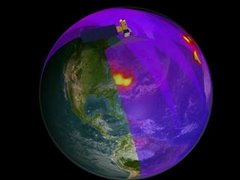
Aura Sees Volcanic Plumes in Near Real-Time


Orbiting 700 km above the Earth, NASA’s Aura spacecraft is responsible for keeping an eye on the health of our atmosphere. So, when a volcano decides to cough some of its fumes into the air, Aura is there to see it. That’s what happened during the January 1, 2008 eruption of the Llaima Volcano in Chile. As the volcano erupted, Aura orbited overhead and picked up the SO2 emissions from the volcano. The resulting image shows the movement of the plume of volcanic gas over the Atlantic Ocean. In addition to understanding the movement of air masses in the atmosphere, tracking volcanic plumes is important because the resulting ash and acidic air masses can cause damage to aircraft. This isn’t the first time Aura was able to spot volcanic plumes. Scientists studying Aura data were also able to track the eruption of the Anatahan and Soufriere Hills Volcanic eruptions in 2005 and 2006, respectively.

For more information about how Aura tracks the volcanic eruptions, visit the following websites:

http://aura.gsfc.nasa.gov/science/feature-010308.html


http://aura.gsfc.nasa.gov/science/feature-062006.html

http://earthobservatory.nasa.gov/NaturalHazards/natural_hazards_v2.php3?img_id=12854

Monday, February 11, 2008

A Blip in Time Makes Nine…

On its long journey to Pluto, New Horizons has very little to do but sit and ponder the great Pluto debate. But occasionally, the spacecraft wakes up and takes a look around its neighborhood. Such an instance occurred on October 6, 2007. The Long-Range Reconnaissance Imager (LORRI) aboard New Horizons woke up and took a high-resolution look around. Low and behold, LORRI spotted Pluto! It took an exposure of 0.967 seconds to get enough light off the surface of Pluto to be able to see it in the image.


To read the press release about this image, visit:

http://pluto.jhuapl.edu/news_center/news/012408.htm