Showing posts with label EOS Aura. Show all posts

Monday, November 17, 2008

Aura Spies California Wildfires


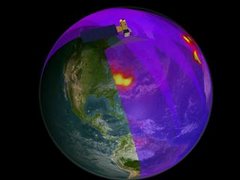
Smoke from the recent outbreak of fires in Southern California can clearly be seen via NASA satellites. On the left, a red-green-blue (RGB) image from the Moderate Resolution Imaging Spectroradiometer (MODIS) on NASA's Aqua satellite shows the smoke being blown to the west from the Los Angeles basin to the waters of the Pacific Ocean on November 16, 2008. On the right, measurements of the Aerosol Index taken by the Ozone Monitoring Instrument (OMI) onboard NASA's Aura satellite are overlayed on top of the MODIS image. As can be seen in this image, the Aerosol Index, which measures the difference in the amount of ultraviolet (UV) light the atmosphere scatters back at given place and time to the amount of UV light that the atmosphere would scatter back if it were totally clear, can effectively detect smoke that is otherwise hard to detect via MODIS imagery as that smoke is transported over bright surfaces such as the low level marine stratocumulus clouds just off the coast. As a result, UV measurements from instruments such as OMI can be used to help detemine the effect such aerosols have on clouds.

MODIS image courtesy the MODIS Rapid Response web site.
OMI AI image courtesy Colin Seftor, NASA Atmospheric Chemistry and Dynamics Branch

Thursday, September 25, 2008

Stratospheric Ozone Hole Reaches New Yearly Low


As always, Aura is monitoring stratospheric ozone levels. Yesterday, the "hole" or thinning over Antarctica reached a new low concentration - 106 Dobson units - for 2008.

Each year, ozone levels in the stratosphere drop in the Arctic and Antarctic in their respective winters. Cold temperatures in the atmosphere result in isolation of the air masses above the Arctic and Antarctic circles. This isolation, along with cold temperatures promote chemical reactions that favor the release of a chlorine atom from chemical compounds such as chlorofluorocarbons (CFCs). This Cl atom attaches itself to an oxygen atom and removes it from the ozone molecule. The result is a reduction of ozone in the ozone layer. This process is seasonal - once spring comes around and atmospheric temperatures rise, the isolated air masses return to normal circulation and the chemical reactions that caused the release of chlorine are no longer viable. Ozone levels in the stratosphere then return to normal.

Why are we so interested in stratospheric ozone hole? The ozone in the stratosphere protects all living beings on earth from harmful ultraviolet-c radiation. This uv-c causes the DNA in cells to break down, which can result in cancer. Without the ozone layer, uv-c would be able to penetrate the atmosphere and it would wreak havoc on all living things.

The Aura spacecraft also measures the other chemical players in the reactions that lead to the break down of ozone in the stratosphere in order to better understand how these reactions happen. This understanding can lead to the prevention of the release of chemicals that cause ozone loss into the atmosphere.

Tuesday, September 16, 2008

Launch Fest at Goddard Space Flight Center


We are all recovering from Launch Fest, an open house that was held at Goddard Space Flight Center (GSFC) on September 13. According to estimates from our Public Affairs Office, 13,000 people came to see what GSFC is all about! Each of our projects were represented in some way:

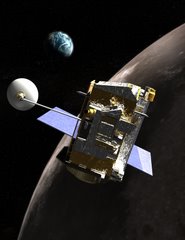
  • LRO had exhibits and displays outside of the white room, where the spacecraft was prominently on display
  • Aura had banners and activities that discussed the role of uv radiation in the processes that control the stratospheric ozone hole
  • SAM opened its doors to the Mars atmosphere simulation chamber and showed animations of the Mars Science Lab doing geochemistry on Mars
  • LOLA displayed the engineering model of the instrument along with the heritage instruments MOLA and MLA (aboard MESSENGER), as well as animations of what data from LRO will look like
  • New Horizons had animations of the spacecraft and science results from the Jupiter flyby
Our scientists and engineers did a wonderful job talking about the work they do at GSFC as well as how Goddard contributes to exploration.

Friday, April 25, 2008

Atmosphere: Change is in the Air

Several years ago I had the opportunity to work with the Smithsonian Institution Natural History Museum on an exhibit about the Earth's atmosphere. The EOS Aura education and outreach program funded the creation of the "Atmosphere: Change is in the Air" exhibit as part of the Smithsonian's "Forces of Change" program. I work at NASA Goddard Space Flight Center, a very cool (in a geeky sort of way) place-but when I got my temporary badge for the Natural History Museum I felt like a little kid... my pass to go behind the scenes at Natural History!! I worked with scientists, exhibit developers and graphic designers and learned how I little I knew about story telling through museum exhibits. The final product included large panels, interactive kiosks, movies and still images from satellites and my favorite component- the Oxygen Theater (you can find this video and other images and stills in the Media Library of the Forces of Change webiste)

Here is more information on the "Atmosphere: Change is in the Air" website:

Explore Earth’s changing atmosphere. Discover how our ever-changing atmosphere transports substances around the globe, protects life from destruction, and supports millions of chemical reactions. Find out how scientists track changes in the atmosphere and why they matter to everything that breathes.

This web site incorporates images and information from the Atmosphere: Change is in the Air exhibition developed by the Smithsonian’s National Museum of Natural History, which was on display at the Museum through November 2006. The exhibition explores the chemistry, properties, and significance of earth’s atmosphere—the invisible envelope that surrounds and affects us all.

Monday, November 26, 2007

Lesson: Investigating Seasonal Variation in NO2 Concentrations

This lesson was written using Aura data, so that students could use data in their own scientific investigations. Below is an overview of the lesson:

The dataset used in this lesson is monthly averages of NO2 as measured from NASA's EOS Aura spacecraft. NO2 is measured using the Ozone Monitoring Instrument (OMI). OMI is a nadir-pointing instrument that measures trace gases in a column of air directly below the spacecraft. NO2 concentrations are measured in number densities, or the amount of NO2 molecules found in a cubic centimeter of air. Alternately, units of parts per billion can be used, as in the graph at the top of the page. This tells how many NO2 molecules would be found in a sample containing a billion molecules of air. The OMI instrument measures the amount of NO2 in the entire vertical column of air below it, thus the units for OMI measurements are molecules per square centimeter (of the surface).

Purpose: Students will examine data in several formats in order to determine the presence or absence of seasonal variability in tropospheric nitrogen dioxide (NO2) concentrations

For the full lesson plan, please visit the following website:

http://mynasadata.larc.nasa.gov/preview_lesson.php?&passid=59

Wednesday, July 18, 2007

Three new NASA Explorer Schools (NES) come to Goddard


Yesterday I had the opportunity to meet with the members of the three new NES for the Goddard service region and show them all of the great professional development opportunities related to Aura. One of the members of the Goddard Office of Education arranged to have all of the Earth Science educators from center come and give a ten to fifteen minute preview of their educational programs. The new NES schools were treated to a smorgasbord of materials from Aura, IceSat, Landsat 7, and MESSENGER. Wearing my Aura hat, I offered opportunities to be trained on materials relating to air quality (ozone and NO2 production) and the stratospheric ozone layer (ultraviolet radiation). The NES team was particularly interested in the ultraviolet activities, and was very adamant about getting me to visit Elizabeth, NJ to give a professional development workshop! One member from each of the teams were grouped together and given an introduction to the Aura Ozone Monitoring Garden by my colleague Jeannie Allen. All in all, the teams seemed extremely interested in getting their hands on the wealth of materials GSFC Earth Science had to offer, which was great!

Wednesday, May 30, 2007

Girls Scouts USA

I'm at the Edith Macy Conference Center in Briarcliff Manor, NY, participating in a STEM training for Girl Scout Council Staff. I'll be discussing Global Warming and NASA's role in monitoring climate change. Part of my challenge is to encourage the "what can I do" types of discussion and the other part is to bring science data into the mix.

Tuesday, May 15, 2007

Aura

Well, Stephanie seems to be very successful in sucking me and Heather (aka "The Kids" or "Steph's minions") into the blogosphere, so here I am. Today I am ramping up my efforts towards Aura, preparing for the AccessData workshop next week. Keep checking back to see how our progress in writing a chapter for the Earth Exploration Toolbook is going!