The GLOBE (Global Learning and Observations to Benefit the Environment) program was the brainchild of Al Gore..conceived when he was Vice President. Gore envisioned school children from across the world making science measurements that scientists could use as part of their research on environment.
From the
GLOBE website:
Announced in 1994, GLOBE began operations on Earth Day 1995. Today, the international GLOBE network has grown to include representatives from 109 participating countries and 135 U.S. Partners coordinating GLOBE activities that are integrated into their local and regional communities. Due to their efforts, there are more than 40000 GLOBE-trained teachers representing over 20000 schools around the world. GLOBE students have contributed more than 16 million measurements to the GLOBE database for use in their inquiry-based science projects.
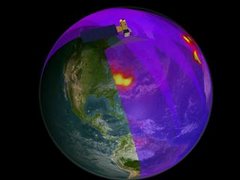
I became involved in GLOBE several years into the project as the Co-Investigator on the GLOBE Soils Investigation. Later, when I started working with Aura EPO we partnered with the GLOBE Aerosols Investigation Co-I to have students take ground-based Aerosols and UV measurements for satellite validation. Check out
"Enhancing Research and Education through Partnerships" to learn more about GLOBE and Aura.
On August 1st I will become a member of one of the new GLOBE Investigations:
Seasons and Biomes.
I'm excited about working in GLOBE again, especially during this time that concern for our environment has become an important issue again.
Here's a summary of the project:
The Seasons and Biomes Project is an inquiry- and project- based initiative that monitors seasons, specifically their interannual variability, in order to increase K-12 students’ understanding of the Earth system. Seasons and Biomes connects GLOBE students, teachers, and communities, with educators andscientists from three Earth Systems Science Programs: International Arctic Research Center (IARC), NASA Landsat Data Continuity (LDCM), and Terra Satellite Missions.
How can studying seasonal change help students better understand Earth as a system? Seasons connect all five spheres of the Earth system - atmosphere, biosphere, cryosphere, hydrosphere and lithosphere– and the interaction between these five spheres affect the timing and duration of seasons. By monitoring seasons, students will increase their understanding of how interactions within the Earth system affect their local seasons and how in turn variations in seasons affect their communities as well as regional and global environments.
What is a Global Learning Community (GLC)?For the Seasons and Biomes Project our GLOBE Learning Community will be an international network of GLOBE schools organized by biomes. A biome is a large geographic area of distinctive plant and animal groups maintained under the climatic conditions of the region. Students in each GLC will monitor their seasons through field campaigns using GLOBE protocols that have been adapted specifically for their biomes. In addition, ice and mosquito phenology protocols will be adapted for Arctic/Subarctic and Tropical regions, respectively. The project will target two GLCs each year and focus on the Tundra and Taiga biomes initially.
What about satellite data?Landsat and MODIS satellite data will be used to teach students what biomes are, how they are classified, and how to identify their region’s biome. In turn, the students’ field measurements collected during their field campaigns will validate the satellite data.