Showing posts with label atmospheric chemistry. Show all posts

Friday, April 25, 2008

Atmosphere: Change is in the Air

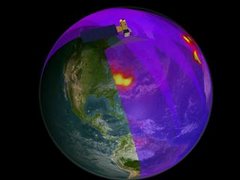
Several years ago I had the opportunity to work with the Smithsonian Institution Natural History Museum on an exhibit about the Earth's atmosphere. The EOS Aura education and outreach program funded the creation of the "Atmosphere: Change is in the Air" exhibit as part of the Smithsonian's "Forces of Change" program. I work at NASA Goddard Space Flight Center, a very cool (in a geeky sort of way) place-but when I got my temporary badge for the Natural History Museum I felt like a little kid... my pass to go behind the scenes at Natural History!! I worked with scientists, exhibit developers and graphic designers and learned how I little I knew about story telling through museum exhibits. The final product included large panels, interactive kiosks, movies and still images from satellites and my favorite component- the Oxygen Theater (you can find this video and other images and stills in the Media Library of the Forces of Change webiste)

Here is more information on the "Atmosphere: Change is in the Air" website:

Explore Earth’s changing atmosphere. Discover how our ever-changing atmosphere transports substances around the globe, protects life from destruction, and supports millions of chemical reactions. Find out how scientists track changes in the atmosphere and why they matter to everything that breathes.

This web site incorporates images and information from the Atmosphere: Change is in the Air exhibition developed by the Smithsonian’s National Museum of Natural History, which was on display at the Museum through November 2006. The exhibition explores the chemistry, properties, and significance of earth’s atmosphere—the invisible envelope that surrounds and affects us all.

Monday, November 26, 2007

Lesson: Investigating Seasonal Variation in NO2 Concentrations

This lesson was written using Aura data, so that students could use data in their own scientific investigations. Below is an overview of the lesson:

The dataset used in this lesson is monthly averages of NO2 as measured from NASA's EOS Aura spacecraft. NO2 is measured using the Ozone Monitoring Instrument (OMI). OMI is a nadir-pointing instrument that measures trace gases in a column of air directly below the spacecraft. NO2 concentrations are measured in number densities, or the amount of NO2 molecules found in a cubic centimeter of air. Alternately, units of parts per billion can be used, as in the graph at the top of the page. This tells how many NO2 molecules would be found in a sample containing a billion molecules of air. The OMI instrument measures the amount of NO2 in the entire vertical column of air below it, thus the units for OMI measurements are molecules per square centimeter (of the surface).

Purpose: Students will examine data in several formats in order to determine the presence or absence of seasonal variability in tropospheric nitrogen dioxide (NO2) concentrations

For the full lesson plan, please visit the following website:

http://mynasadata.larc.nasa.gov/preview_lesson.php?&passid=59

Wednesday, May 30, 2007

Girls Scouts USA

I'm at the Edith Macy Conference Center in Briarcliff Manor, NY, participating in a STEM training for Girl Scout Council Staff. I'll be discussing Global Warming and NASA's role in monitoring climate change. Part of my challenge is to encourage the "what can I do" types of discussion and the other part is to bring science data into the mix.

Tuesday, May 15, 2007

Aura

Well, Stephanie seems to be very successful in sucking me and Heather (aka "The Kids" or "Steph's minions") into the blogosphere, so here I am. Today I am ramping up my efforts towards Aura, preparing for the AccessData workshop next week. Keep checking back to see how our progress in writing a chapter for the Earth Exploration Toolbook is going!