Wednesday, November 12, 2008

DIGITAL LEARNING NETWORK HOSTS WORLDWIDE VIRTUAL PARTY FOR NASA

Schools all over the world will wish NASA a happy birthday as part of an all-day virtual birthday party through NASA's Digital Learning Network on Thursday, Nov. 13.

The virtual party begins at 9 a.m. EST with live videoconferences occurring every hour on the hour until 6 p.m. Schools from Canada, Australia, the United Kingdom, Japan, Mexico City, India, Slovenia and New Zealand will participate in the live digital connection.

During each webcast, international schools will connect with a U.S. school and one of NASA's 10 field centers. Each Digital Learning Network site will host a 45-minute videoconference featuring a unique program in NASA's 50 years of discovery and exploration in science, aeronautics and space.

Webcast topics for NASA's 50th birthday party include (all times EST):

- Space shuttle, hosted at NASA's Kennedy Space Center in Florida at 9 a.m.

- Project Mercury, hosted at NASA's Marshall Space Flight Center in Huntsville, Ala., at 10 a.m.

- The Viking Project, hosted at NASA's Langley Research Center in Hampton, Va., at 11 a.m.

- Hubble Space Telescope, hosted at NASA's Goddard Space Flight Center in Greenbelt, Md., at noon.

- Project Gemini, hosted at NASA's Johnson Space Center in Houston at 1 p.m.

- Stennis Space Center history, hosted at NASA's Stennis Space Center in Mississippi at 2 p.m.

- X-43, hosted at NASA's Dryden Flight Research Center in Edwards, Calif., at 3 p.m.

- Icing Tunnel, hosted at NASA's Glenn Research Center in Cleveland at 4 p.m.

- Arc Jet Facility, hosted at NASA's Ames Research Center in Moffett Field, Calif., at 5 p.m.

- Phoenix Mars Lander, hosted at NASA's Jet Propulsion Laboratory in Pasadena, Calif., at 6 p.m.

The birthday party is being held through a partnership among NASA, Discovery Education of Silver Spring, Md., the U.S. Distance Learning Association of Boston and Polycom of Pleasanton, Calif.

NASA's Digital Learning Network began in the spring of 2004 with three hub sites at Langley, Glenn and Johnson and now extends to all 10 field centers. Through interactive videoconferencing, the network allows the next generation of explorers to connect with scientists, engineers and researchers without leaving the classroom. The distance-learning events are designed to educate through demonstrations and live interactions with NASA experts.

To view the live webcasts on Nov. 13, visit:

http://dln.nasa.gov/dln/content/webcast


For more information about NASA's education programs, visit:

www.nasa.gov/education

Thursday, October 2, 2008

Educators to Share MESSENGER's Second Mercury Flyby

On Monday, October 6, 2008, NASA's MESSENGER mission to Mercury will complete an important milestone, as the spacecraft makes its second flyby of its target planet. During the flyby, MESSENGER will swoop just 200 km (125 miles) above the cratered surface of Mercury, snapping hundreds of pictures and collecting a variety of other data from the planet as it gains a critical gravity assist that keeps the probe on track to become the first spacecraft ever to orbit the innermost planet in the Solar System in 2011.

Six MESSENGER Educator Fellows, master science educators talented atspeaking to audiences of all ages and backgrounds, will observe the flyby activities at the Mission Operations Center at the Johns Hopkins University Applied Physics Laboratory and report on their experiences in real time using social networking sites on the Internet. Through the Fellows' eyes, teachers, students, and the general public around the world will be able to share the engineers' excitement as the spacecraft performs a maneuver crucial to the success of the mission, and experience the scientists' exhilaration as new science data never before seen by any human being arrives during the days following the flyby.

Join the MESSENGER Educator Fellows as they report on MESSENGER's second flyby of Mercury by navigating to the Fellows at the Flyby page at: http://btc.montana.edu/messenger/teachers/flyby.php
Follow the links therein to the individual Fellows' Facebook, Twitter, Wiki and blog pages.

The MESSENGER to Mercury mission is supported by the NASA Discovery Program under contract to the Carnegie Institution of Washington and the Johns Hopkins University Applied Physics Laboratory. For more information on the
MESSENGER mission, visit http://messenger.jhuapl.edu/

Thursday, September 25, 2008

Stratospheric Ozone Hole Reaches New Yearly Low


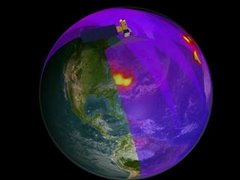
As always, Aura is monitoring stratospheric ozone levels. Yesterday, the "hole" or thinning over Antarctica reached a new low concentration - 106 Dobson units - for 2008.

Each year, ozone levels in the stratosphere drop in the Arctic and Antarctic in their respective winters. Cold temperatures in the atmosphere result in isolation of the air masses above the Arctic and Antarctic circles. This isolation, along with cold temperatures promote chemical reactions that favor the release of a chlorine atom from chemical compounds such as chlorofluorocarbons (CFCs). This Cl atom attaches itself to an oxygen atom and removes it from the ozone molecule. The result is a reduction of ozone in the ozone layer. This process is seasonal - once spring comes around and atmospheric temperatures rise, the isolated air masses return to normal circulation and the chemical reactions that caused the release of chlorine are no longer viable. Ozone levels in the stratosphere then return to normal.

Why are we so interested in stratospheric ozone hole? The ozone in the stratosphere protects all living beings on earth from harmful ultraviolet-c radiation. This uv-c causes the DNA in cells to break down, which can result in cancer. Without the ozone layer, uv-c would be able to penetrate the atmosphere and it would wreak havoc on all living things.

The Aura spacecraft also measures the other chemical players in the reactions that lead to the break down of ozone in the stratosphere in order to better understand how these reactions happen. This understanding can lead to the prevention of the release of chemicals that cause ozone loss into the atmosphere.