Showing posts with label LRO. Show all posts

Monday, April 26, 2010

80 Miles to Play-Doh Part I: When Without, Improvise!


Last week, I had the privilege of traveling to Chinle, AZ to participate in a series of educational activities related to the Moon and LRO. Traveling from the DC area, I flew to Albuquerque on Sunday in preparation for a scouting trip to Meteor and Sunset Craters on Monday. Tuesday evening, my colleagues and I were to lead an evening's worth of activities that included viewing the Moon through a telescope and discussing how scientists use Earth analogs to understand the processes that occur elsewhere in the solar system.

Monday evening, one of my fellow NASA educators mentioned that it would be a good idea to prep some hands-on activities for the students for the evening's events. After all, if we're going to be discussing volcanoes and impact craters, why not have the students investigate how they're made in the first place? We all agreed that it was a good idea and decided on our drive back to Chinle from Flagstaff that we would go to the grocery store in the morning to pick up supplies. For those of you whom have never made volcanoes in the classroom, you need the following supplies:

baking soda
vinegar
paper plates
paper cups
paper towels
clear straws
play-doh

Now, most of the items on the above list can be readily found at any grocery store - after all, they're all pretty common in the baking isle. On the other hand, play-doh isn't an item typically found in the grocery store. If you happen to live in an urban area, any pharmacy or big-box store would most likely have play-doh. However, if you're in Chinle, AZ, the closest big-box store or pharmacy is over 80 miles away (one-way), and in another state! So here's where our plan got interesting. There are plenty of home-made play-doh recipes out there, but most of them call for you to cook your dough (or at least to include boiling water). What's an educator to do?

My colleagues and I wandered through the small grocery store, searching desperately on our slow cell phone internet connections for a recipe to make play-doh that doesn't involve cooking. The non-cook play-doh options weren't viable for us, so we were stuck. "Wait a minute," I exclaimed, "we can use the coffee pot to heat the water up!"

So, there we were. It was 3 pm, 4 hours before the event was scheduled to start. Pouring flour, salt, cream of tartar, kool-aid, oil, and water heated in the coffee pot into the sink in the hotel bathroom. Yep, I said the sink! Turns out, a hotel sink is a perfect bowl to make home-made play-doh, and it's easy clean up. I couldn't help but laugh at our situation. If you ever asked me if I ever thought my job would have me on a Navajo reservation, 80 miles from the nearest Wal-mart, mixing play-doh in a hotel sink, I would have answered with the requisite "are you crazy?" We made cherry, orange, mango, and grape colored/flavored play-doh. The grape play-doh looked like a warm, giant ball of chewed bubblicious gum. :-P

The event turned out really well. We had about 60 people, made up of families with kids of all ages show up for our event. Everyone had a great time making volcanoes out of our home-made play-doh and learning how impact craters are made. The clouds even (mostly) cooperated with us, enabling everyone to get a close up sight of the Moon through the telescope!

Saturday, June 20, 2009

LRO Launch!


Seriously. I have to keep pinching myself to see if it's really real. This despite a first-person eyewitness of the launch, numerous phone calls from my hubby about how well things are going, and lots and lots of rocket eye candy. This week at Cocoa Beach has been a whirlwind experience. As soon as I landed on Thursday June 11th, I hit the ground running. Lots of organization, making sure speakers were well taken care of, planning, re-planning, and stressing out over making sure that everything went smoothly. Then the news that the Saturday expected launch of STS-127 was scrubbed (the news came at a brutal 3:45 am) due to a hydrogen leak in the tank, and that the window for our launch was being "negotiated." Admittedly, my Type-A self didn't take this news very well. I had been planning for this week for what seemed like forever, and to me it was a no-brainer as to the fact that LRO should clearly get our entire window. Us getting pushed meant that we had to scramble to find people to cover the exhibits and public presentations at the Visitor Center. So I was stressed. A. Lot.

Then we found out that the second attempt for STS-127 was scrubbed, and that we would get our first opportunity to launch on the second day of our window - June 18th. Now we're talking!

Launch day arrived. My stress levels had miraculously decreased. I felt calm, cool, and for the first time in several weeks, actually excited about our launch! We loaded the first bus (well, we hadn't planned on it, but that's the way it worked out) to the Banana Creek viewing site. We're ready for launch! A few hours of hanging out, eating a soft pretzel and ice cream, picking primo seats in the bleachers, and playing the waiting game for launch. While we were waiting, we had news that the weather was looking grave, and there was a better chance of the weather clearing if we pushed forward to our last opportunity at 5:32 pm. I had promised I would call in to the auditorium at Goddard where employees were gathered to give my perspective on the launch. Given the weather situation, I asked everyone in the auditorium to take a deep breath and blow in the southeast direction to clear out the storm clouds. Talk about timing, because right after I said that, a voice came over the speaker and announced that our weather conditions turned to green! We're go for launch!

What a sight. The engines lit, and our little spacecraft that could was carried up into the sky and ahead to its destination - the Moon! I cried. And I cried some more. And I cried so much that the next day my eyelids were swollen. All of that time, energy, stress, excitement, anticipation, and joy were wrapped up in that one moment in time. LRO lifted off at 5:32:00.1 pm EDT - one tenth of one second late. That moment, that singular point in time is forever recorded in my brain as the moment that all of our collective dreams became a reality. I could feel all of the people who have worked on this mission at that moment.

And all of that was just the beginning. LRO is on its way to the Moon!

Tuesday, September 16, 2008

Launch Fest at Goddard Space Flight Center


We are all recovering from Launch Fest, an open house that was held at Goddard Space Flight Center (GSFC) on September 13. According to estimates from our Public Affairs Office, 13,000 people came to see what GSFC is all about! Each of our projects were represented in some way:

  • LRO had exhibits and displays outside of the white room, where the spacecraft was prominently on display
  • Aura had banners and activities that discussed the role of uv radiation in the processes that control the stratospheric ozone hole
  • SAM opened its doors to the Mars atmosphere simulation chamber and showed animations of the Mars Science Lab doing geochemistry on Mars
  • LOLA displayed the engineering model of the instrument along with the heritage instruments MOLA and MLA (aboard MESSENGER), as well as animations of what data from LRO will look like
  • New Horizons had animations of the spacecraft and science results from the Jupiter flyby
Our scientists and engineers did a wonderful job talking about the work they do at GSFC as well as how Goddard contributes to exploration.

Friday, July 11, 2008

LRO Update

Ok, I was inspired to write this post because of the picture that was sent out by our Project Manager, Craig Tooley. Let me just get this out of my system - LRO is HOT! Ok. I feel better now.

The picture to the left is of LRO on what is called an Aronson table. The Aronson table enables our engineers to move the spacecraft to different orientations (ie, put the spacecraft on different sides) for testing purposes.


Right now, our spacecraft is undergoing CPT, or Comprehensive Performance Test. This is where we check out all of the systems on the spacecraft while we simulate going through various stages in flight. Our engineers are working around the clock to make sure that everything is functioning properly. You can think of it like doing a practice run before we actually go into space. These tests are critical to working out all the bugs!

LRO has also simultaneously been undergoing the blanketing process. The entire spacecraft needs to be covered in protective material to ensure that it is kept "warm" while in space. The blanket material is the shiny metallic coverings seen on the above photo. The blanketing process is one of the last hardware processes. The last thing that needs to be done to the spacecraft is the installation of the solar array, which is scheduled for Monday, July 14. Once the installation of the solar array is over, LRO will be completely assembled!

Tuesday, July 1, 2008

Extended Deadline - Send your name to the Moon with LRO!

Have you ever wanted to go to the Moon, but didn't have the money? What about going for free? If you haven't yet signed up to send your name to the Moon, you still have time! Due to overwhelming response from people around the world, we have decided to extend the deadline to send your name to the Moon!

You have until July 25th to send in your name and get your certificate! Don't forget to tell your friends and family too.

Friday, May 2, 2008

Would you like to go to the Moon?

At this time, NASA is not sending people there, just LRO and LCROSS. But you can send a little part of yourself there... your name.

The Send Your Name to the Moon Web site enables everyone to participate in NASA's lunar adventure and place their names in orbit around the Moon for years to come. Participants can submit their information at http://lro.jhuapl.edu/NameToMoon/, print a certificate and have their name entered into a database. The database will be placed on a microchip that will be integrated onto the LRO spacecraft. The deadline for submitting names is June 27, 2008.


While you're online, check out the new videos on the LRO mission page: http://www.nasa.gov/mission_pages/LRO/main/index.html

Join us at the Moon!!

Monday, March 3, 2008

LRO Looking like a spacecraft!

Howdy folks. Last week was a really exciting week for us here at Goddard Space Flight Center. On Thursday, February 28, four of the six outermost panels were attached to the propulsion module! We were sure to capture the exciting progress so all of you could see it too! The video included in this blog shows the hard-working people of LRO in the clean room assembling the bits and pieces of the spacecraft. You'll first see the avionics panel being set upright. Then the propulsion tank assembly is brought into the tent, and the instrument module, reaction wheel, and avionics panels are attached. As you can see, our little spacecraft is growing up!

Friday, February 22, 2008

NASA Goddard Space Flight Center-WETA All Access

On Thursday, February 28, 2008, at 8:00 pm WETA TV 26 will broadcast "NASA Goddard Space Flight Center-WETA All Access". This 30 minute feature covers the Center's major achievements in space flight, the ins and outs of a space mission, earthbound work, and the extensive and impressive team behind it all. This is a Washington DC station. Please http://www.weta.org for video of this program.


WETA announcement available at: http://www.weta.org/pressroom/allaccess/

Thursday, February 21, 2008

On the Road for LRO: Earthquake!

Hi all! I just wanted to let you know that I'm here in Salt Lake City for the International Technology Education Association (ITEA) Conference, and as I was sitting here this morning, I felt the 6.3 Magnitude earthquake that was centered near Wells, NV.

I have never been in an earthquake before, so imagine my surprise as I was sitting here doing some work, and felt the bed begin to shake! I looked up from the computer and could see the contrast of the white comforter cover moving against the dark wood furniture. The first thing I did was IM my fiance and tell him the bed was shaking. I got up to look out the window to see if anything was moving outside, but I couldn't detect any movement. I sat back down on the bed, and lo and behold, it was still shaking.

I can tell you that the timing of this thing couldn't have been more fortuitous for me. I have been to California many times before, and was never lucky enough to feel an earthquake. And since I arrived last night, I am still on East Coast time, so I was awake and aware this morning when the ground began to shake. And, this is the most intense earthquake the area has felt in quite awhile.

The news is currently reporting damage from Wells, and so far, there are no reports of injuries.

Well, that's all. I just wanted to give you a firsthand account of an earthquake, coming to you from Salt Lake City!

Friday, February 8, 2008

What will radiation do to Moon travelers?? LRO will find out!


Check out this video of astronomer Harlan Spence talking about CRaTER (Cosmic Ray Telescope for the Effects of Radiation), an experiment that will be on the Lunar Reconnaissance Orbiter when it launches later this year. CRaTER will collect data on the Moon's radiation environment. This information will help engineers design spacecraft, spacesuits, and habitats that wil protect the astronauts that will one day travel to and live on the Moon.

For you science teachers out there that will be attending next month's National Science Teachers Association meeting in Boston, Dr. Spence will be giving a presentation on CRaTER, LRO and the Moon on Sunday (3/30/08) from 11am-noon in Room 257A of the Boston Convention Center. Check it out!! And while you're there, also check out the NASA booth in the exhibit hall. Most of us bloggers from Adventures in Earth and Space will be there.

Wednesday, February 6, 2008

Rock and Rocket Science

Back in November Bruce Springsteen and the E-Street Band did two concerts at the Verizon Center in Washington DC. We invited the band and the crew for a tour of Goddard and behind the scenes look at the LRO mission. Five members of the crew came to visit (photos here).


Kurt Wolak, the keyboard programmer on the tour sent me this message comparing rock to rocket science a few days after their visit. The pictures in this post are from their tour of Goddard.


On this tour I am a keyboard programmer (and re-programmer). In the world of instrument techs, we are often referred to as the rocket scientists, huddled over our displays punching buttons and twirling jog wheels. Due to your graciousness, I have now confabbed with real rocket scientists in the rocket scientist clubhouse.


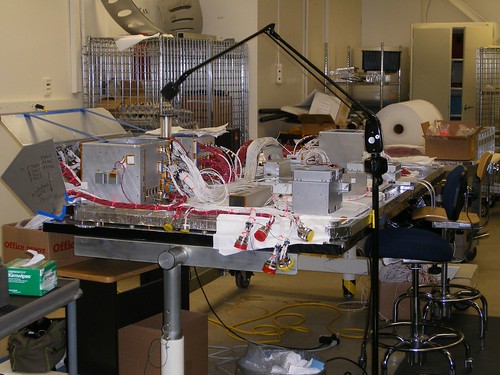
After I saw the room with the flat sat and the test team, I had to laugh on how similar my workspace looks and operates when I am designing and setting up a keyboard rig for a tour.

Additionally:
It must be able to be delivered to a predetermined set of coordinates, deploy, perform a mission, and return safely. It must be re-deployable again and again, or the next show will be, well, deplorable.


It is assembled from instruments constructed by different teams from different countries at different points in time. Sometimes components are pillaged from previous missions for cost and timeline reasons. Somehow this disparate pile needs to communicate and function together, so...
We drag all that stuff (and the stuff to test that stuff, and the stuff needed to fix the stuff once the test stuff confirms that something's whack) and a big pile of cable and connectors into a room, set it up on some tables and equipment stands and after (insert indeterminate number of hours and dollars, pizza and beer), we make it work, debug, improve, increase robustness.


We build mock ups redundant systems/components and data capture/backup are part of the design criteria. Technical support from the component manufacturers can be a daunting prospect.


We build complex wiring harnesses using a variety of connectors and ports. There are people in our field who are specialists at this; these harnesses are a core component and vital to continued mission success.

Fortunately, the technology we use is quite advanced. One of the most commonly used connection systems was designed in the 1920's, abandoned long ago by the original specifier. Our primary communication protocol - MIDI - that allows keyboard components to talk to each other is based on a serial hexadecimal language created in the late 70's. It has never been replaced.

There isn't even a MIDI 2.0. Most all keyboards and similar components using MIDI have a specific button or easily executed key command on the work surface labeled PANIC, used when the buffer overloads. The name and the fact that it even exists gives you all the info you need to know.


Once the system has been thoroughly tested, there is a burn in period. We then load the components into the specialized housings specified for the mission; it's often a tight fit with close tolerances. These housings and others are gathered together and become the payload, literally, in the transport vehicles. Many a manager have told many a promoter upon arrival, "We are not unloading the (expletive) truck unless you (expletive) pay us first!"

We operate in a universe in which stars explode, implode, collide, change their color (usually only the hair, but not always) increase in diameter, dim, die. Some of them exhibit behaviors that seem beyond the laws of physics, or at least beyond the law. Quantum mechanics apply; quasi-Shroedinger effects are commonly observed, in which someone is expected to be in two positions at once.

Surrounding these stars is a collection of lesser bodies that have been pulled into orbits around the stars. Planets, moons, objects; band, crew, poseurs - we each have our nomenclature. Nebulous clouds of gas are common, some of them inept. Inert, sorry. Bowing to your tradition of classical references, we call these egos, alternatively, "I am god!" or "Oh, my god..." (OMG's), from the Latin.

Solar flares do erupt, sometimes with local consequences. Dark matter exists, we work with it every day. Unlike you, we have regular contact and communication - more or less - with alien life forms, though our associates working on another project in this mission, the GTR (Guitar Tuning and Repair) techs, inform us that it is sometimes easier just to hand them their instrument and walk away. I trust their data.


The root of rocket is rock.


Therefore, in this newfound spirit of co-compatriosity, at the end of our mission, I would like to propose a test to be conducted in your massive centrifuge room, involving the keyboard rig I am 'project manager' of, and a ball of jute twine that has been soaking in a puddle of biodiesel in one of the bays of the tour bus for the lastyear. Maybe call it the Tour Twine Tensile Test or something catchy like that. Up to twenty five G's, huh? I'll spring for the stickers...


Thanks again and good luck with the LRO project. I will track your

project. Congrats.


Kurt Wolak
c/o Thrill Hill Production/Bruce Springsteen and the E Street Band 2007

Wednesday, November 28, 2007

Tweeting from the LRO Project Science Working Group Meeting

The Lunar Reconnaissance Orbiter is the first step in NASA's return to the moon. LRO will launch in late 2008 with the objectives to finding safe landing sites, locate potential resources, characterize the radiation environment, and demonstrate new technology. I'm the Education and Public Outreach (EPO) lead for LRO. I'm using twitter to provide updates of the LRO Project Science Working Group (PSWG) that is taking place at Goddard Nov 28-30. You can follow my tweets here or in realtime at twitter.com/geosteph.

Project Manager Craig Tooley is doing the "State of the Project" overview. The current launch date is October 28 2008. Greetings from the Lunar Reconnaissance Orbiter (LRO) Project Science Working Group meeting...live from NASA Goddard Space Flight Center!

Learn more about LRO at http://lro.gsfc.nasa.gov/ check the progress of the spacecraft assembly at http://lro.gsfc.nasa.gov/ha...

Link to instruments http://lro.gsfc.nasa.gov/in... and pics http://www.flickr.com/photo...


Craig just mentioned the Bruce Springsteen road crew tour." I got the most interesting technical questions from this group" during the tour

60 Minutes, BBC, Discovery, WETA, NPR Canada have all been out to capture LRO on film

Next up Joanne Baker with the LRO Orbiter Lever Integration and Test presentation

Joanne is talking about what instrument teams can expect during the integration of their instruments to the spacecraft.

All the instruments be tested before they are integrated...environmental tests ..vibe, thermal vac, acoustics and shock, EMC


new avatar FlatSat - mock up of where instruments go on LRO...in prep for instrument integration


RIck Saylor is discussing the Mission Operations Center--the MOC is where LRO will be commanded and controlled after launch

The LRO MOC is in buidling 32 at Goddard...right next door to my building
The MOC also receives LRO telemetry and data and processed and distributes data to the instrument Science Operations Center-- the SOCs

Stan Scott is now speaking about the LRO Data Working Group. The group includes LRO folks and instrument team members

So, each instrument has a Science Operations Center..that processes it's own data after receiving it from LRO;

Within six months the LRO instrument data is provided to NASA's Planetary Data System (PDS) http://pds/index.html

All NASA Planetary missions are required to deliver data to PDS w/in six months of data acquisition by the instrument teams.

LRO instruments CrATER http://lro.gsfc.nasa.gov/cr... - effects of the lunar radiation environment on tissue equivalent plastic


LEND measures the flux of neutrons on the moon..http://lro.gsfc.nasa.gov/le... is the Russian contribution to LRO

LEND will use neutron flux to determine hydrogen concentration on the lunar surface - looking for possible sources of water


Next up is LOLA..the Lunar Orbiter Laser Altimeter... http://lro.gsfc.nasa.gov/lola.html

LOLA will make 140 measurements/second. measures range to surface (topography) surface slope, surface reflectance and surface roughness

Reflectance measurements may allow LOLA to "see" water ice in the permanently shadowed regions on the Moon

LOLA PI Dave Smith " ...a negative rock would be a hole" as LOLA 'sees' it

LOLA will do laser ranging-Earth Based laser tracking stations will range to LRO via LOLA for improved LRO timing and orbit determination

The LRO camera is up now with PI Mark Robinson http://lro.gsfc.nasa.gov/lr..

LROC has a wide angle and narrow angle camera.. LROC's measurement objectives are here: http://lroc.sese.asu.edu/ob.

LROC's narrow angle cameras will give us 25x better image resolution than the current lunar data sets

Diviner will measure lunar surface temperatures at scales that provide information for future surface operations and exploration

Diviner will map global day and night temperatures http://lro.gsfc.nasa.gov/di

LAMP is the Lyman-Alpha Mapping Project http://lro.gsfc.nasa.gov/la... UV from starlight to see in shadowed regions on the Moon

The LAMP instrument is an exact copy of the Alice instrument on New Horizons http://pluto.jhuapl.edu/spa...

The LAMP website has a great summary of the search for water on the moon: http://www.boulder.swri.edu...

Now a talk on the LRO launch window: there are 2 opportunities to go to the moon each day...

Launch window is 2-3 days every two weeks that gives us the optimal lunar orbit


Discussion from LOLA PI Dave Smith about what LRO will do in it's science phase after year 1

LRO's nominal orbit is 50 Km above the lunar surface.

Dave says we will know the topography and gravity field very well after the first year of operations..so we could lower the orbit to 5-10 km

we will find the highest point on the moon when we hit it-eventually LRO will run out of fuel & will have an abrupt landing

Check out the LRO promo http://tinyurl.com/2f8cb9