Showing posts with label Sample Analysis at Mars. Show all posts

Tuesday, September 16, 2008

Launch Fest at Goddard Space Flight Center


We are all recovering from Launch Fest, an open house that was held at Goddard Space Flight Center (GSFC) on September 13. According to estimates from our Public Affairs Office, 13,000 people came to see what GSFC is all about! Each of our projects were represented in some way:

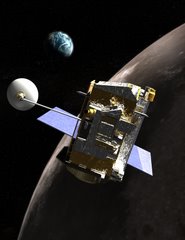
  • LRO had exhibits and displays outside of the white room, where the spacecraft was prominently on display
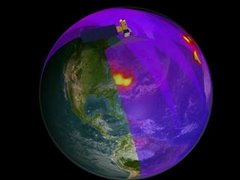
  • Aura had banners and activities that discussed the role of uv radiation in the processes that control the stratospheric ozone hole
  • SAM opened its doors to the Mars atmosphere simulation chamber and showed animations of the Mars Science Lab doing geochemistry on Mars
  • LOLA displayed the engineering model of the instrument along with the heritage instruments MOLA and MLA (aboard MESSENGER), as well as animations of what data from LRO will look like
  • New Horizons had animations of the spacecraft and science results from the Jupiter flyby
Our scientists and engineers did a wonderful job talking about the work they do at GSFC as well as how Goddard contributes to exploration.

Wednesday, February 27, 2008

"Follow the Carbon." Follow the What??


Recently I had the pleasure of writing an article about the Sample Analysis at Mars (SAM) suite of instruments onboard the Mars Science Laboratory (MSL) for the February 2008 issue of ChemMatters, which is a publication of the American Chemical Society for high school classrooms. Below is an excerpt from the article. To download and read the entire article (including a Spanish translation) and issue, as well as to access the accompanying teacher's guide, click here.

“Follow the yellow brick road”. “Follow the leader”. You’re probably familiar with both of these phrases. But who would want to “follow the carbon” and what does that even mean? To NASA, “follow the carbon” means to identify carbon-bearing compounds, their sources, and the processes that transform them in order to evaluate the habitability of Mars. And that is exactly what the Sample Analysis at Mars (SAM) suite of instruments onboard the Mars Science Laboratory (MSL) intends to do. MSL is scheduled to launch in late 2009 and will land on the surface of Mars in mid 2010, where it will spend at least one Mars year (687 Earth days) roving around the surface and collecting data. MSL will be the biggest rover yet to visit Mars. It will also carry the biggest suite of instruments ever sent to the martian surface, including a camera, neutron detector, laser, microscope, and an analytical laboratory. SAM is one component of this laboratory. SAM plans to “find the carbon” on Mars by collecting samples of the soil and atmosphere and analyzing them with three scientific instruments. Using the results obtained by the SAM instruments, scientists back on Earth will seek to investigate the habitability of Mars by answering the question, “What do the presence or absence and characteristics of key compounds at Mars tell us about the ability of Mars to support past or present life?”