Showing posts with label moon. Show all posts

Monday, April 26, 2010

80 Miles to Play-Doh Part I: When Without, Improvise!


Last week, I had the privilege of traveling to Chinle, AZ to participate in a series of educational activities related to the Moon and LRO. Traveling from the DC area, I flew to Albuquerque on Sunday in preparation for a scouting trip to Meteor and Sunset Craters on Monday. Tuesday evening, my colleagues and I were to lead an evening's worth of activities that included viewing the Moon through a telescope and discussing how scientists use Earth analogs to understand the processes that occur elsewhere in the solar system.

Monday evening, one of my fellow NASA educators mentioned that it would be a good idea to prep some hands-on activities for the students for the evening's events. After all, if we're going to be discussing volcanoes and impact craters, why not have the students investigate how they're made in the first place? We all agreed that it was a good idea and decided on our drive back to Chinle from Flagstaff that we would go to the grocery store in the morning to pick up supplies. For those of you whom have never made volcanoes in the classroom, you need the following supplies:

baking soda
vinegar
paper plates
paper cups
paper towels
clear straws
play-doh

Now, most of the items on the above list can be readily found at any grocery store - after all, they're all pretty common in the baking isle. On the other hand, play-doh isn't an item typically found in the grocery store. If you happen to live in an urban area, any pharmacy or big-box store would most likely have play-doh. However, if you're in Chinle, AZ, the closest big-box store or pharmacy is over 80 miles away (one-way), and in another state! So here's where our plan got interesting. There are plenty of home-made play-doh recipes out there, but most of them call for you to cook your dough (or at least to include boiling water). What's an educator to do?

My colleagues and I wandered through the small grocery store, searching desperately on our slow cell phone internet connections for a recipe to make play-doh that doesn't involve cooking. The non-cook play-doh options weren't viable for us, so we were stuck. "Wait a minute," I exclaimed, "we can use the coffee pot to heat the water up!"

So, there we were. It was 3 pm, 4 hours before the event was scheduled to start. Pouring flour, salt, cream of tartar, kool-aid, oil, and water heated in the coffee pot into the sink in the hotel bathroom. Yep, I said the sink! Turns out, a hotel sink is a perfect bowl to make home-made play-doh, and it's easy clean up. I couldn't help but laugh at our situation. If you ever asked me if I ever thought my job would have me on a Navajo reservation, 80 miles from the nearest Wal-mart, mixing play-doh in a hotel sink, I would have answered with the requisite "are you crazy?" We made cherry, orange, mango, and grape colored/flavored play-doh. The grape play-doh looked like a warm, giant ball of chewed bubblicious gum. :-P

The event turned out really well. We had about 60 people, made up of families with kids of all ages show up for our event. Everyone had a great time making volcanoes out of our home-made play-doh and learning how impact craters are made. The clouds even (mostly) cooperated with us, enabling everyone to get a close up sight of the Moon through the telescope!

Saturday, June 20, 2009

LRO Launch!


Seriously. I have to keep pinching myself to see if it's really real. This despite a first-person eyewitness of the launch, numerous phone calls from my hubby about how well things are going, and lots and lots of rocket eye candy. This week at Cocoa Beach has been a whirlwind experience. As soon as I landed on Thursday June 11th, I hit the ground running. Lots of organization, making sure speakers were well taken care of, planning, re-planning, and stressing out over making sure that everything went smoothly. Then the news that the Saturday expected launch of STS-127 was scrubbed (the news came at a brutal 3:45 am) due to a hydrogen leak in the tank, and that the window for our launch was being "negotiated." Admittedly, my Type-A self didn't take this news very well. I had been planning for this week for what seemed like forever, and to me it was a no-brainer as to the fact that LRO should clearly get our entire window. Us getting pushed meant that we had to scramble to find people to cover the exhibits and public presentations at the Visitor Center. So I was stressed. A. Lot.

Then we found out that the second attempt for STS-127 was scrubbed, and that we would get our first opportunity to launch on the second day of our window - June 18th. Now we're talking!

Launch day arrived. My stress levels had miraculously decreased. I felt calm, cool, and for the first time in several weeks, actually excited about our launch! We loaded the first bus (well, we hadn't planned on it, but that's the way it worked out) to the Banana Creek viewing site. We're ready for launch! A few hours of hanging out, eating a soft pretzel and ice cream, picking primo seats in the bleachers, and playing the waiting game for launch. While we were waiting, we had news that the weather was looking grave, and there was a better chance of the weather clearing if we pushed forward to our last opportunity at 5:32 pm. I had promised I would call in to the auditorium at Goddard where employees were gathered to give my perspective on the launch. Given the weather situation, I asked everyone in the auditorium to take a deep breath and blow in the southeast direction to clear out the storm clouds. Talk about timing, because right after I said that, a voice came over the speaker and announced that our weather conditions turned to green! We're go for launch!

What a sight. The engines lit, and our little spacecraft that could was carried up into the sky and ahead to its destination - the Moon! I cried. And I cried some more. And I cried so much that the next day my eyelids were swollen. All of that time, energy, stress, excitement, anticipation, and joy were wrapped up in that one moment in time. LRO lifted off at 5:32:00.1 pm EDT - one tenth of one second late. That moment, that singular point in time is forever recorded in my brain as the moment that all of our collective dreams became a reality. I could feel all of the people who have worked on this mission at that moment.

And all of that was just the beginning. LRO is on its way to the Moon!

Friday, July 11, 2008

LRO Update

Ok, I was inspired to write this post because of the picture that was sent out by our Project Manager, Craig Tooley. Let me just get this out of my system - LRO is HOT! Ok. I feel better now.

The picture to the left is of LRO on what is called an Aronson table. The Aronson table enables our engineers to move the spacecraft to different orientations (ie, put the spacecraft on different sides) for testing purposes.


Right now, our spacecraft is undergoing CPT, or Comprehensive Performance Test. This is where we check out all of the systems on the spacecraft while we simulate going through various stages in flight. Our engineers are working around the clock to make sure that everything is functioning properly. You can think of it like doing a practice run before we actually go into space. These tests are critical to working out all the bugs!

LRO has also simultaneously been undergoing the blanketing process. The entire spacecraft needs to be covered in protective material to ensure that it is kept "warm" while in space. The blanket material is the shiny metallic coverings seen on the above photo. The blanketing process is one of the last hardware processes. The last thing that needs to be done to the spacecraft is the installation of the solar array, which is scheduled for Monday, July 14. Once the installation of the solar array is over, LRO will be completely assembled!

Tuesday, July 1, 2008

Extended Deadline - Send your name to the Moon with LRO!

Have you ever wanted to go to the Moon, but didn't have the money? What about going for free? If you haven't yet signed up to send your name to the Moon, you still have time! Due to overwhelming response from people around the world, we have decided to extend the deadline to send your name to the Moon!

You have until July 25th to send in your name and get your certificate! Don't forget to tell your friends and family too.

Wednesday, February 20, 2008

View Tonight's Total Lunar Eclipse - The Last One Until 2010!


Tonight, February 20, 2008, will be your last opportunity to view a total lunar eclipse until December 2010. A lunar eclipse occurs when the Earth lines up directly between the Sun and Moon such that the Earth's shadow completely covers the Moon's surface. Tonight's eclipse will last for about 3.5 hours, 50 minutes of which the Moon will be in totality. During the eclipse the Moon will change color from gray to red. This is due to the glow cast on the Moon from indirect sunlight passing through Earth's atmosphere. The Moon's color during an eclipse varies based on the amounts of dust and clouds in the Earth's atmosphere. The more dust in the Earth's atmosphere, the more red the Moon will appear. The United States will be able to view the majority of the eclipse. Click on the above map above to determine your best viewing times.

To learn more about tonight's eclipse, see the NASA Eclipse Home Page and this NASA feature story. To learn more about eclipse terminology, see the Educator's Guide to Eclipses. Click here for a classroom activity on creating two scale models of the Earth-Moon system that can be used to demonstrate lunar phases and eclipses. Click here for an eclipse viewing activity for students.

Happy viewing!!!

Friday, February 8, 2008

What will radiation do to Moon travelers?? LRO will find out!


Check out this video of astronomer Harlan Spence talking about CRaTER (Cosmic Ray Telescope for the Effects of Radiation), an experiment that will be on the Lunar Reconnaissance Orbiter when it launches later this year. CRaTER will collect data on the Moon's radiation environment. This information will help engineers design spacecraft, spacesuits, and habitats that wil protect the astronauts that will one day travel to and live on the Moon.

For you science teachers out there that will be attending next month's National Science Teachers Association meeting in Boston, Dr. Spence will be giving a presentation on CRaTER, LRO and the Moon on Sunday (3/30/08) from 11am-noon in Room 257A of the Boston Convention Center. Check it out!! And while you're there, also check out the NASA booth in the exhibit hall. Most of us bloggers from Adventures in Earth and Space will be there.

Wednesday, November 28, 2007

Tweeting from the LRO Project Science Working Group Meeting

The Lunar Reconnaissance Orbiter is the first step in NASA's return to the moon. LRO will launch in late 2008 with the objectives to finding safe landing sites, locate potential resources, characterize the radiation environment, and demonstrate new technology. I'm the Education and Public Outreach (EPO) lead for LRO. I'm using twitter to provide updates of the LRO Project Science Working Group (PSWG) that is taking place at Goddard Nov 28-30. You can follow my tweets here or in realtime at twitter.com/geosteph.

Project Manager Craig Tooley is doing the "State of the Project" overview. The current launch date is October 28 2008. Greetings from the Lunar Reconnaissance Orbiter (LRO) Project Science Working Group meeting...live from NASA Goddard Space Flight Center!

Learn more about LRO at http://lro.gsfc.nasa.gov/ check the progress of the spacecraft assembly at http://lro.gsfc.nasa.gov/ha...

Link to instruments http://lro.gsfc.nasa.gov/in... and pics http://www.flickr.com/photo...


Craig just mentioned the Bruce Springsteen road crew tour." I got the most interesting technical questions from this group" during the tour

60 Minutes, BBC, Discovery, WETA, NPR Canada have all been out to capture LRO on film

Next up Joanne Baker with the LRO Orbiter Lever Integration and Test presentation

Joanne is talking about what instrument teams can expect during the integration of their instruments to the spacecraft.

All the instruments be tested before they are integrated...environmental tests ..vibe, thermal vac, acoustics and shock, EMC


new avatar FlatSat - mock up of where instruments go on LRO...in prep for instrument integration


RIck Saylor is discussing the Mission Operations Center--the MOC is where LRO will be commanded and controlled after launch

The LRO MOC is in buidling 32 at Goddard...right next door to my building
The MOC also receives LRO telemetry and data and processed and distributes data to the instrument Science Operations Center-- the SOCs

Stan Scott is now speaking about the LRO Data Working Group. The group includes LRO folks and instrument team members

So, each instrument has a Science Operations Center..that processes it's own data after receiving it from LRO;

Within six months the LRO instrument data is provided to NASA's Planetary Data System (PDS) http://pds/index.html

All NASA Planetary missions are required to deliver data to PDS w/in six months of data acquisition by the instrument teams.

LRO instruments CrATER http://lro.gsfc.nasa.gov/cr... - effects of the lunar radiation environment on tissue equivalent plastic


LEND measures the flux of neutrons on the moon..http://lro.gsfc.nasa.gov/le... is the Russian contribution to LRO

LEND will use neutron flux to determine hydrogen concentration on the lunar surface - looking for possible sources of water


Next up is LOLA..the Lunar Orbiter Laser Altimeter... http://lro.gsfc.nasa.gov/lola.html

LOLA will make 140 measurements/second. measures range to surface (topography) surface slope, surface reflectance and surface roughness

Reflectance measurements may allow LOLA to "see" water ice in the permanently shadowed regions on the Moon

LOLA PI Dave Smith " ...a negative rock would be a hole" as LOLA 'sees' it

LOLA will do laser ranging-Earth Based laser tracking stations will range to LRO via LOLA for improved LRO timing and orbit determination

The LRO camera is up now with PI Mark Robinson http://lro.gsfc.nasa.gov/lr..

LROC has a wide angle and narrow angle camera.. LROC's measurement objectives are here: http://lroc.sese.asu.edu/ob.

LROC's narrow angle cameras will give us 25x better image resolution than the current lunar data sets

Diviner will measure lunar surface temperatures at scales that provide information for future surface operations and exploration

Diviner will map global day and night temperatures http://lro.gsfc.nasa.gov/di

LAMP is the Lyman-Alpha Mapping Project http://lro.gsfc.nasa.gov/la... UV from starlight to see in shadowed regions on the Moon

The LAMP instrument is an exact copy of the Alice instrument on New Horizons http://pluto.jhuapl.edu/spa...

The LAMP website has a great summary of the search for water on the moon: http://www.boulder.swri.edu...

Now a talk on the LRO launch window: there are 2 opportunities to go to the moon each day...

Launch window is 2-3 days every two weeks that gives us the optimal lunar orbit


Discussion from LOLA PI Dave Smith about what LRO will do in it's science phase after year 1

LRO's nominal orbit is 50 Km above the lunar surface.

Dave says we will know the topography and gravity field very well after the first year of operations..so we could lower the orbit to 5-10 km

we will find the highest point on the moon when we hit it-eventually LRO will run out of fuel & will have an abrupt landing

Check out the LRO promo http://tinyurl.com/2f8cb9


Monday, November 12, 2007

How Big is the Moon - Activity


Have you ever wondered how big the Moon was relative to the Earth? Since it is not possible to shrink the Earth and Moon, the following activity allows you to gain a better understanding using a piece of string and some image cut outs. This activity also allows you to use a regulation size basketball and a tennis ball to represent both the Earth and the Moon. By wrapping a piece of string around the 'equator' part of the basketball 9.5 times, this will be equivalent to the distance you would have to place the tennis ball at to have an accurate scale model.

For more information and images on how to do this activity please visit.

Monday, October 22, 2007

ASTC Day 3

More highlights from my time at the ASTC meeting...

Sunday, October 14, 2007


Keynote

This morning's keynote had two speakers - Adam and Jamie from the Discovery Channel's MythBusters!! I have to admit that although I'd heard of MythBusters, I'd never actually watched an episode. After hearing Jamie and Adam talk however and seeing how truly interested they are in helping teach us a little science through debunking urban legends, I have to say I plan to start watching. It was really cool to hear them talk about how they became interested in science, how they come up with ideas for the show, and how difficult it can be to convince the producers (and their insurance agents!) to let them go through with said ideas. A highlight of their keynote was getting to view never-before-aired footage from "Facts about Flatulence". You'll have to check it out for yourself...

Experience Design session
Aside from helping to work the NASA booth, I attended a session on Experience Design. The session focused on encouraging visitor learning through themed experiences. For example, the Franklin Institute in Philadelphia (site of the 2008 ASTC meeting) has created a series of programs in which school groups don't just visit the museum, see a bunch of exhibits and/or presentations about unrelated topics, and then leave. Instead, their visits, called "Experiences", focus on a central them from start to finish such that
the experience provides "hands-on, auditory and visual reinforcement". Experiences focus on a featured exhibit, the theme of which is coordinated with a hands-on workshop, an interactive science show, and a thematically related IMAX or planetarium show. An example is their "Identity Experience". Another one of the presenters was an Imagineer for Disney. He talked about the work that went into designing and building the new Finding Nemo Submarine Voyage attraction that opened this summer at Disneyland in CA.

Field Trip to the Moon
Later in the day I got to see a screening of the new Field Trip to the Moon DVD in one of the inflatable domes in the exhibit hall. As I mentioned in an earlier post, the DVD and related educational materials, which were developed by the American Museum of Natural History with help from NASA, are FREE! Click here for details. It was fabulous and I highly recommend you check it out. One of the great things about it is that there's a captioned version and an un-captioned version so that you can make up your own script to fit your audience, learning objectives, etc.

Field Trip to the Museum of Jurassic Technology
Later that afternoon I had a chance to visit the Museum of Jurassic Technology. The MJT is awesome!! I was so excited to visit it after having read case studies about it in my museum classes at ASU. Some of you may be familiar with it from the book Mr. Wilson's Cabinet of Wonders: Pronged Ants, Horned Humans, Mice on Toast, and Other Marvels of Jurassic Technology by Lawrence Weschler. As its name implies, the MJT is a place of contradictions and juxtaposition (since the Jurassic period ended about 145 million years ago) in the style of the cabinets of curiosities that were popular in the 16th and 17th centuries and that preceded the modern museum . The MJT mixes science, art, reality, and fiction so well that you leave it questioning your ability to distinguish between them. A visit to the MJT is a lesson on the importance of critical thinking and how we shouldn't always believe everything we read, hear, or see. It's also an exploration of what it takes to make a museum - must a "museum" have objects, display cases, text panels, even a building in order to function as such??

California Science Center
The evening ended with an after-hours party at the California Science Center. I had a ton of fun wandering around the exhibits and meeting new people (and eating lots of food). The CSS is impressive in its size, scope, and programs. A really cool aspect of the CSS is that they actually have an elementary school on site called the Science Center School. How cool would it be to be able to utilize the unique resources of a science center as a student or teacher??

Stay tuned for Day 4 tomorrow...

Monday, August 20, 2007

Twittering from the NASA IPY Meeting

I am currently sitting in the NASA International Polar Year education and public outreach meeting. During the meeting I am twittering the meeting highlights....here are my tweets from the from the first session.

in the IPY meeting! Jim Garvin is talking about polar regions on the Moon and Mars http://tinyurl.com/2eqhz9


Wow! Jim has the new LRO spacecraft visualization! Really cool (in a geeky sort of way) http://lunar.gsfc.nasa.gov

now Jim is talking about Mars polar regions here's Jim http://tinyurl.com/28orru

I want Jim Garvin's Moon and Mars visualizations! We are meeting in GSFC's Science Visualization Studio http://svs.gsfc.nasa.gov/

Geeking out at high res images from MRO http://mars.jpl.nasa.gov/mro/ of the north polar region of Mars

now Jim is talking about Phoenix mission. It launched 2 weeks ago. Check out the video http://phoenix.lpl.arizona.edu/videos.php


Check out the NASA and IPY Video
http://ipy.nasa.gov/multimedia/m000000/m000000/m000015/index.html

NASA Antarctic researcher Bob Bindschadler is talking about LIMA ..Landsat Image Mosaic of Antarctica http://lima.usgs.gov/

LIMA: Faces of Antarctica is the education project that will introduce people to Antarctica. Website launches 10/07 http://lima.nasa.gov/

Now the guy from Earth & Sky, Ryan Britton http://www.earthsky.org/

Earth & Sky do radio shows on NASA polar science in english and spanish and podcasts over the next two years. Also social networks: MySpace


Lots of good discussions at lunch ... Now back to Twitter!

Now the GLOBE presentation http://www.globe.gov with a focus on the earth systems science projects

GLOBE Seasons and Biomes http://tinyurl.com/yr7zan

Bob Myers is talking about ESSEA http://essea.strategies.org/ Earth Systems Science Education Alliance online courses for science teachers

The ESSEA courses evolved from just online to combination of online and face-to-face. 3 courses K-4, 5-8, 9-12

Over 1700 preservice and inservice teachers were trained between 2002 and 2005 through ESSEA semester long courses

NASA IPY ESSEA project is to update K-4 course with polar themes and add some polar content to middle and high school courses

Teachers interested in taking an ESSEA course check out current course offerings http://essea.strategies.org/participants/offerings.aspx

DEW Digital Earth Watch...lead by museum of science in Boston with 6 partners uses plant health to monitor the environment

Now one of our projects Sharing IPY to Librarians and Afters School programs

This IPY project builds on "Explore fun with Science" http://www.lpi.usra.edu/education/explore/


Thursday, June 28, 2007

LRO Library Workshop in Arizona!


We received notice from two participants in our Tempe Lunar Librarians workshop that they are doing a series of programs on LRO this summer. The workshops will take place July and August in Tucson at the Valencia Branch Library.

Sunday, May 20, 2007

Lunar Librarians and after school program providers too!

Through our work on education and outreach on LRO, we partnered with the Lunar and Planetary Institute (LPI) and their Explore: Fun with Science project. From the website: Explore! Fun with Science is designed to engage youth in space and planetary science in the library and other informal learning environments. Through video explorations, related hands-on activities, and supporting resources, children of all ages are immersed in the wonders of rockets, space colonies, our solar system, how our planets were shaped, and more!

The LRO Spacecraft as envisioned by one of the participants of our Colorado workshop held at the Denver Museum of Nature and Science May 8-9.

LPI worked with our team to create the Explore: To the Moon and Beyond with LRO module. They have the expertise in developing materials and activities for library and after-school programs, and we have the content and cool images and visualizations. Together we have conducted two-day workshops for librarians in Arizona, Colorado, Delaware, Maryland and Pennsylvania. During the workshops we include hands-on activities designed for children and have LRO scientists and engineers talk to the participants about the upcoming LRO mission.

Lava Layers activity includes creating maps and simulating drill coring.

Saturday, May 12, 2007

Added mission links


I just added the links to my missions and projects. Check out the education and/or outreach sections to get an idea of the kinds of things we do.

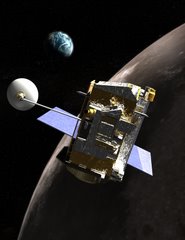
The image at the left is the Lunar Reconnaissance Orbiter. It's scheduled to launch late October 2008