Friday, February 8, 2008

What will radiation do to Moon travelers?? LRO will find out!


Check out this video of astronomer Harlan Spence talking about CRaTER (Cosmic Ray Telescope for the Effects of Radiation), an experiment that will be on the Lunar Reconnaissance Orbiter when it launches later this year. CRaTER will collect data on the Moon's radiation environment. This information will help engineers design spacecraft, spacesuits, and habitats that wil protect the astronauts that will one day travel to and live on the Moon.

For you science teachers out there that will be attending next month's National Science Teachers Association meeting in Boston, Dr. Spence will be giving a presentation on CRaTER, LRO and the Moon on Sunday (3/30/08) from 11am-noon in Room 257A of the Boston Convention Center. Check it out!! And while you're there, also check out the NASA booth in the exhibit hall. Most of us bloggers from Adventures in Earth and Space will be there.

Wednesday, February 6, 2008

Rock and Rocket Science

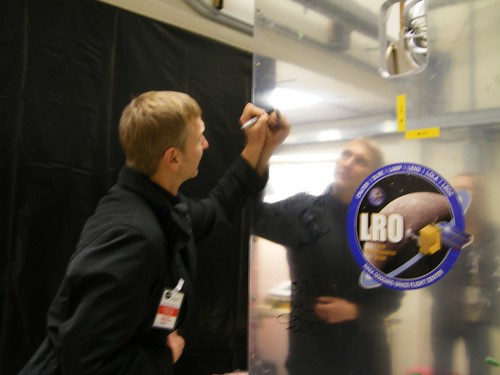
Back in November Bruce Springsteen and the E-Street Band did two concerts at the Verizon Center in Washington DC. We invited the band and the crew for a tour of Goddard and behind the scenes look at the LRO mission. Five members of the crew came to visit (photos here).


Kurt Wolak, the keyboard programmer on the tour sent me this message comparing rock to rocket science a few days after their visit. The pictures in this post are from their tour of Goddard.


On this tour I am a keyboard programmer (and re-programmer). In the world of instrument techs, we are often referred to as the rocket scientists, huddled over our displays punching buttons and twirling jog wheels. Due to your graciousness, I have now confabbed with real rocket scientists in the rocket scientist clubhouse.


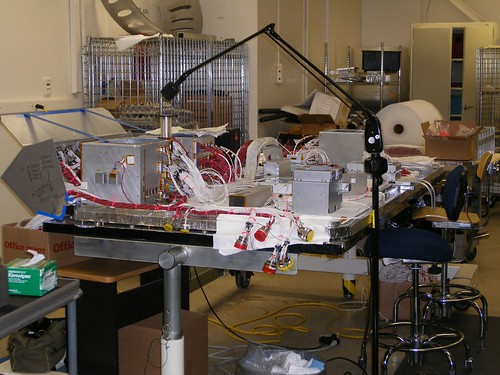
After I saw the room with the flat sat and the test team, I had to laugh on how similar my workspace looks and operates when I am designing and setting up a keyboard rig for a tour.

Additionally:
It must be able to be delivered to a predetermined set of coordinates, deploy, perform a mission, and return safely. It must be re-deployable again and again, or the next show will be, well, deplorable.


It is assembled from instruments constructed by different teams from different countries at different points in time. Sometimes components are pillaged from previous missions for cost and timeline reasons. Somehow this disparate pile needs to communicate and function together, so...
We drag all that stuff (and the stuff to test that stuff, and the stuff needed to fix the stuff once the test stuff confirms that something's whack) and a big pile of cable and connectors into a room, set it up on some tables and equipment stands and after (insert indeterminate number of hours and dollars, pizza and beer), we make it work, debug, improve, increase robustness.


We build mock ups redundant systems/components and data capture/backup are part of the design criteria. Technical support from the component manufacturers can be a daunting prospect.


We build complex wiring harnesses using a variety of connectors and ports. There are people in our field who are specialists at this; these harnesses are a core component and vital to continued mission success.

Fortunately, the technology we use is quite advanced. One of the most commonly used connection systems was designed in the 1920's, abandoned long ago by the original specifier. Our primary communication protocol - MIDI - that allows keyboard components to talk to each other is based on a serial hexadecimal language created in the late 70's. It has never been replaced.

There isn't even a MIDI 2.0. Most all keyboards and similar components using MIDI have a specific button or easily executed key command on the work surface labeled PANIC, used when the buffer overloads. The name and the fact that it even exists gives you all the info you need to know.


Once the system has been thoroughly tested, there is a burn in period. We then load the components into the specialized housings specified for the mission; it's often a tight fit with close tolerances. These housings and others are gathered together and become the payload, literally, in the transport vehicles. Many a manager have told many a promoter upon arrival, "We are not unloading the (expletive) truck unless you (expletive) pay us first!"

We operate in a universe in which stars explode, implode, collide, change their color (usually only the hair, but not always) increase in diameter, dim, die. Some of them exhibit behaviors that seem beyond the laws of physics, or at least beyond the law. Quantum mechanics apply; quasi-Shroedinger effects are commonly observed, in which someone is expected to be in two positions at once.

Surrounding these stars is a collection of lesser bodies that have been pulled into orbits around the stars. Planets, moons, objects; band, crew, poseurs - we each have our nomenclature. Nebulous clouds of gas are common, some of them inept. Inert, sorry. Bowing to your tradition of classical references, we call these egos, alternatively, "I am god!" or "Oh, my god..." (OMG's), from the Latin.

Solar flares do erupt, sometimes with local consequences. Dark matter exists, we work with it every day. Unlike you, we have regular contact and communication - more or less - with alien life forms, though our associates working on another project in this mission, the GTR (Guitar Tuning and Repair) techs, inform us that it is sometimes easier just to hand them their instrument and walk away. I trust their data.


The root of rocket is rock.


Therefore, in this newfound spirit of co-compatriosity, at the end of our mission, I would like to propose a test to be conducted in your massive centrifuge room, involving the keyboard rig I am 'project manager' of, and a ball of jute twine that has been soaking in a puddle of biodiesel in one of the bays of the tour bus for the lastyear. Maybe call it the Tour Twine Tensile Test or something catchy like that. Up to twenty five G's, huh? I'll spring for the stickers...


Thanks again and good luck with the LRO project. I will track your

project. Congrats.


Kurt Wolak
c/o Thrill Hill Production/Bruce Springsteen and the E Street Band 2007

Thursday, January 24, 2008

Tweeting from the NASA Earth Science Update


Hi all,

Here are some updates from NASA Earth Sciences, as tweeted earlier today:

NASA spending 1.5 billion on Earth Science in FY08

OSTM and OCO being launched this year

7 Earth Science missions in development

Dr. Alan Stern, Associate Administrator for Science Mission Directorate

NASA Earth Science: 14 Earth satellites in commission, 8 spacecraft to be launched in the next 5 years

Stern: Earth Science is one of NASA's "best kept secrets"

OSTM: Launch 6/16, GOES-O (weather satellite!) Launch 8/8; OCO Launch 12/15

Orbiting Carbon Observatory (OCO): First-time measurements of global carbon dioxide sources and sinks

Aquarius (Launch 2010): First time measurements of sea surface salinity from space

The A-Train is comprised of 5 satellites flying in close formation (including Aura!)

Synergy of spacecraft flying in close formation gives us more info than any one satellite flying alone

Six thematic areas of Earth science research: climate variability and change; atmospheric composition; weather; carbon cycle;

(cont): tectonic processes; water and energy cycles

NASA DC8 flying over boreal forest and examining impact of air pollution over arctic air masses - summer '08

NASA Earth science accomplishments 2007:

NASA observations have contributed to climate change projects (i.e.: IPCC Report)

QuickScat measured record decline in arctic sea ice cover

Area of sea ice lost: comparable to area of TX and CA combined

IceSAT: Arctic sea ice is thinning and shriking. Old ice is being replaced by newer, thinner sea ice

Aeronomy of Ice in the Mesosphere (AIM): Polar mesospheric clouds are forming more frequently and at lower latitudes than ever before

Polar Mesospheric cloud change is result of CO2 in atmosphere, cooling in upper atmosphere

Satellites characterized aftermath of Hurricane Katrina

Satellites imaged before and after changes in live vegetation wrt Katrina

NASA measures So Cal wildfires:

Aqua, EOS-1, and unmanned research aircraft got images of fires, showing smoke locations, fire hotspots, and near real-time data

Stay tuned: Specifics about Earth Science response to decadal survey. Once-per-month updates on NASA Earth Science programs and projects

OCO will help us understand the carbon cycle on scales of about 1,000 km, and understand non-anthropogenic background

Miles Brian (CNN): How does NASA plan to handle data gaps?

Stern: NASA satellites have proven to outlive their expectations by factors of 2 and 3. We have a balancing act btwn covering gaps

(cont): and new measurements

Miles Brian (CNN): Are we here because of a change in political climate?

Griffin: No. We are here because we do research, and we do Earth science research well, and we're proud of it.

Monday, January 14, 2008

Hello Mercury!!


The MESSENGER spacecraft will make its first flyby of Mercury today at 2:04:39 pm EST!! This image of Mercury was taken yesterday on January 13 when the spacecraft was at a distance of about 760,000 kilometers (470,000 miles) from Mercury. Mercury is about 4880 kilometers (about 3030 miles) in diameter, and the smallest feature visible in this image is about 20 kilometers (12 miles) across.

During the historic encounter today, extensive scientific data will be gathered. The Mercury Dual Imaging System cameras will acquire more than 1,200 images of Mercury, including images of portions of the surface never before viewed by a spacecraft. The Mercury Atmospheric and Surface Composition Spectrometer will observe Mercury's surface as well as its tenuous atmosphere. The Magnetometer will accurately measure Mercury's magnetic field, and the Energetic Particle and Plasma Spectrometer will characterize Mercury's space environment and interactions with the solar wind. The Mercury Laser Altimeter will sense surface topography along a narrow profile. The Gamma-Ray and Neutron Spectrometer and X-Ray Spectrometer will make the first measurements of Mercury’s surface elemental composition.


MESSENGER will begin to transmit the new data to Earth once all of the scientific measurements are completed, about 22 hours after the spacecraft's closest approach to Mercury. These flyby data will shed light on fundamental scientific questions related to the formation and evolution of the planet Mercury. As scientists analyze the data, the MESSENGER spacecraft will continue on its planned journey, which includes two more encounters of Mercury in October 2008 and September 2009, before entering an orbit around Mercury in March 2011.

Additional information and features from this first flyby will be available online at http://messenger.jhuapl.edu/mer_flyby1.html, so check back frequently. Following the flyby, be sure to check for the latest released images and science results!