Monday, November 26, 2007

Lesson: Investigating Seasonal Variation in NO2 Concentrations

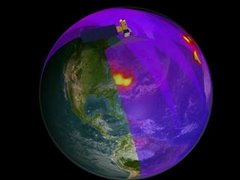
This lesson was written using Aura data, so that students could use data in their own scientific investigations. Below is an overview of the lesson:

The dataset used in this lesson is monthly averages of NO2 as measured from NASA's EOS Aura spacecraft. NO2 is measured using the Ozone Monitoring Instrument (OMI). OMI is a nadir-pointing instrument that measures trace gases in a column of air directly below the spacecraft. NO2 concentrations are measured in number densities, or the amount of NO2 molecules found in a cubic centimeter of air. Alternately, units of parts per billion can be used, as in the graph at the top of the page. This tells how many NO2 molecules would be found in a sample containing a billion molecules of air. The OMI instrument measures the amount of NO2 in the entire vertical column of air below it, thus the units for OMI measurements are molecules per square centimeter (of the surface).

Purpose: Students will examine data in several formats in order to determine the presence or absence of seasonal variability in tropospheric nitrogen dioxide (NO2) concentrations

For the full lesson plan, please visit the following website:

http://mynasadata.larc.nasa.gov/preview_lesson.php?&passid=59

Wednesday, November 14, 2007

Update on LRO's Assembly


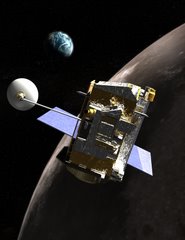
With less than one year to go until launch, the assembly of the Lunar Reconnaissance Orbiter (LRO) spacecraft and its six scientific instruments is in full swing. The actual spacecraft and one of its instruments, the Lunar Orbiter Laser Altimeter (LOLA), are being built here at NASA's Goddard Space Flight Center in MD. Both the spacecraft and all of its instruments must undergo rigorous testing to ensure that they can survive the physical stresses of launch and the extreme environment of space. Each component is exposed to excessive vibrations and extreme hot and cold temperatures in vacuum conditions. In addition, the wiring, electronics, and software is tested and retested to ensure that everything is connected and operating correctly and to ensure the validity of the procedures we'll use to operate the spacecraft and instruments once they're in space. Before we test the actual components that will be traveling into space, we first run the same tests on their mockups! As you can imagine, Goddard engineers and scientists work long and hard to make sure that all of these tests are successful so that the assembly of the spacecraft and its instruments stays on schedule.

Currently, a mockup of the Lunar Exploration Neutron Detector (LEND) instrument is at Goddard to undergo "FlatSat" testing before the actual flight instrument arrives for its own testing next month. "FlatSat" stands for flat satellite and is where all of LRO's electronic components will be laid out and hooked together on a long table and attached electrically like they will be during flight. In addition to testing LRO's components before launch, mission operations will use FlatSat to test commands before sending them to the spacecraft during its actual mission. Click here to see photos of LEND's FlatSat testing and to keep up with other developments in the assembly of LRO.

Monday, November 12, 2007

How Big is the Moon - Activity


Have you ever wondered how big the Moon was relative to the Earth? Since it is not possible to shrink the Earth and Moon, the following activity allows you to gain a better understanding using a piece of string and some image cut outs. This activity also allows you to use a regulation size basketball and a tennis ball to represent both the Earth and the Moon. By wrapping a piece of string around the 'equator' part of the basketball 9.5 times, this will be equivalent to the distance you would have to place the tennis ball at to have an accurate scale model.

For more information and images on how to do this activity please visit.

Wednesday, November 7, 2007

Making Our Way to Mercury Again...


MESSENGER (MErcury Surface, Space ENvironment, GEochemistry, and Ranging), launched August 3, 2004, is NASA's first mission back to Mercury in over 30 years. The first mission to visit Mercury was Mariner 10. It flew by the planet three times between 1974 & 1975. During that time, it only imaged about 45% of Mercury.

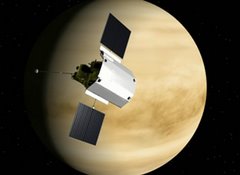
Unlike Mariner 10, MESSENGER is designed to orbit Mercury. But, in order to get there, MESSENGER will make one flyby of the Earth, two flybys of Venus, and three flybys of Mercury. During MESSENGER's three flybys of Mercury, it will have imaged the whole planet. The first of the three flybys will take play on January 14, 2008. It won't be until March 2011 when MESSENGER will enter into an orbit around Mercury.

Once in orbit, MESSENGER will begin to gather data to better understand Mercury and how the other planets formed. Scientist hope to answer the following six questions:
  1. Why is Mercury so dense?
  2. What is the geologic history of Mercury?
  3. What is the nature of Mercury's magnetic field?
  4. What is the structure of Mercury's core?
  5. What are the unusual materials at Mercury's poles?
  6. What volatiles are important at Mercury?
For more information on MESSENGER, please visit: http://messenger.jhuapl.edu/
Stay tuned for future blogs on MESSENGER.