Thursday, July 15, 2010

MESSENGER Fellows Invade DC

Last week the latest cadre of MESSENGER Educator Fellows had their training here in the DC area. Many of the Fellows were able to attend. Here's a group picture along with the PI Dr. Sean Solomon who gave a fabulous presentation about the mission and what is to come.

You may be wondering what in the world is a MESSENGER Fellow. These Fellows, an essential part of the MESSENGER education and public outreach (E/PO) program, are master science teachers who conduct teacher training workshops nationally about the mission. The goal of the program is to train 27,000 grades preK-12 educators.

Using the MESSENGER Education Modules, http://www.messenger-education.org/teachers/educ_modules.php, the Fellows are able to demonstrate that by looking at other planetary objects, such as Mercury or the Moon, one can get a better understanding of the formation of the Earth.

To learn more about the E/PO program, please visit: http://www.messenger-education.org/

Monday, April 26, 2010

80 Miles to Play-Doh Part I: When Without, Improvise!


Last week, I had the privilege of traveling to Chinle, AZ to participate in a series of educational activities related to the Moon and LRO. Traveling from the DC area, I flew to Albuquerque on Sunday in preparation for a scouting trip to Meteor and Sunset Craters on Monday. Tuesday evening, my colleagues and I were to lead an evening's worth of activities that included viewing the Moon through a telescope and discussing how scientists use Earth analogs to understand the processes that occur elsewhere in the solar system.

Monday evening, one of my fellow NASA educators mentioned that it would be a good idea to prep some hands-on activities for the students for the evening's events. After all, if we're going to be discussing volcanoes and impact craters, why not have the students investigate how they're made in the first place? We all agreed that it was a good idea and decided on our drive back to Chinle from Flagstaff that we would go to the grocery store in the morning to pick up supplies. For those of you whom have never made volcanoes in the classroom, you need the following supplies:

baking soda
vinegar
paper plates
paper cups
paper towels
clear straws
play-doh

Now, most of the items on the above list can be readily found at any grocery store - after all, they're all pretty common in the baking isle. On the other hand, play-doh isn't an item typically found in the grocery store. If you happen to live in an urban area, any pharmacy or big-box store would most likely have play-doh. However, if you're in Chinle, AZ, the closest big-box store or pharmacy is over 80 miles away (one-way), and in another state! So here's where our plan got interesting. There are plenty of home-made play-doh recipes out there, but most of them call for you to cook your dough (or at least to include boiling water). What's an educator to do?

My colleagues and I wandered through the small grocery store, searching desperately on our slow cell phone internet connections for a recipe to make play-doh that doesn't involve cooking. The non-cook play-doh options weren't viable for us, so we were stuck. "Wait a minute," I exclaimed, "we can use the coffee pot to heat the water up!"

So, there we were. It was 3 pm, 4 hours before the event was scheduled to start. Pouring flour, salt, cream of tartar, kool-aid, oil, and water heated in the coffee pot into the sink in the hotel bathroom. Yep, I said the sink! Turns out, a hotel sink is a perfect bowl to make home-made play-doh, and it's easy clean up. I couldn't help but laugh at our situation. If you ever asked me if I ever thought my job would have me on a Navajo reservation, 80 miles from the nearest Wal-mart, mixing play-doh in a hotel sink, I would have answered with the requisite "are you crazy?" We made cherry, orange, mango, and grape colored/flavored play-doh. The grape play-doh looked like a warm, giant ball of chewed bubblicious gum. :-P

The event turned out really well. We had about 60 people, made up of families with kids of all ages show up for our event. Everyone had a great time making volcanoes out of our home-made play-doh and learning how impact craters are made. The clouds even (mostly) cooperated with us, enabling everyone to get a close up sight of the Moon through the telescope!

Saturday, June 20, 2009

LRO Launch!


Seriously. I have to keep pinching myself to see if it's really real. This despite a first-person eyewitness of the launch, numerous phone calls from my hubby about how well things are going, and lots and lots of rocket eye candy. This week at Cocoa Beach has been a whirlwind experience. As soon as I landed on Thursday June 11th, I hit the ground running. Lots of organization, making sure speakers were well taken care of, planning, re-planning, and stressing out over making sure that everything went smoothly. Then the news that the Saturday expected launch of STS-127 was scrubbed (the news came at a brutal 3:45 am) due to a hydrogen leak in the tank, and that the window for our launch was being "negotiated." Admittedly, my Type-A self didn't take this news very well. I had been planning for this week for what seemed like forever, and to me it was a no-brainer as to the fact that LRO should clearly get our entire window. Us getting pushed meant that we had to scramble to find people to cover the exhibits and public presentations at the Visitor Center. So I was stressed. A. Lot.

Then we found out that the second attempt for STS-127 was scrubbed, and that we would get our first opportunity to launch on the second day of our window - June 18th. Now we're talking!

Launch day arrived. My stress levels had miraculously decreased. I felt calm, cool, and for the first time in several weeks, actually excited about our launch! We loaded the first bus (well, we hadn't planned on it, but that's the way it worked out) to the Banana Creek viewing site. We're ready for launch! A few hours of hanging out, eating a soft pretzel and ice cream, picking primo seats in the bleachers, and playing the waiting game for launch. While we were waiting, we had news that the weather was looking grave, and there was a better chance of the weather clearing if we pushed forward to our last opportunity at 5:32 pm. I had promised I would call in to the auditorium at Goddard where employees were gathered to give my perspective on the launch. Given the weather situation, I asked everyone in the auditorium to take a deep breath and blow in the southeast direction to clear out the storm clouds. Talk about timing, because right after I said that, a voice came over the speaker and announced that our weather conditions turned to green! We're go for launch!

What a sight. The engines lit, and our little spacecraft that could was carried up into the sky and ahead to its destination - the Moon! I cried. And I cried some more. And I cried so much that the next day my eyelids were swollen. All of that time, energy, stress, excitement, anticipation, and joy were wrapped up in that one moment in time. LRO lifted off at 5:32:00.1 pm EDT - one tenth of one second late. That moment, that singular point in time is forever recorded in my brain as the moment that all of our collective dreams became a reality. I could feel all of the people who have worked on this mission at that moment.

And all of that was just the beginning. LRO is on its way to the Moon!

Tuesday, February 24, 2009

Mourning the Loss of OCO

This morning, the Taurus XL rocket that was to shepherd the Orbiting Carbon Observatory (OCO) to its orbit, 700 km above the Earth's surface, failed deliver its payload. According to the press conference, the Taurus XL fairing (the shell that protects a payload during launch) failed to separate at its scheduled time. The added mass of the fairing prevented the second stage of the rocket from boosting OCO into its orbit. The fairing, with its precious cargo inside, plummeted into the Antarctic Ocean. OCO was the first NASA mission dedicated to measuring CO2 in the atmosphere. Its data would have given NASA Earth scientists a view into the sources, cycles, and sinks of CO2 in the atmosphere, leading to a better understanding of the inputs to global warming processes.

Today, I personally mourn the loss of OCO. I was driving to work at Goddard Space Flight Center this morning when I heard a local radio station announce that "NASA had lost a mission to understand global warming." My heart sunk. I yelled out loud "No, no no! Don't let it be OCO! Don't let it be OCO!" even though I knew in my heart that it was exactly that spacecraft we had lost. It's weird to say that I'm mourning the loss of a satellite. After all, it is only an inanimate object. But being so close to LRO, a mission that's only months out from launching, I understand all too well the amount of effort it takes to design, build, and launch one of these precious commodities. My sadness is felt for those people who were involved in the mission in addition to the loss of the precious scientific data (and resulting understanding) that OCO would have brought.

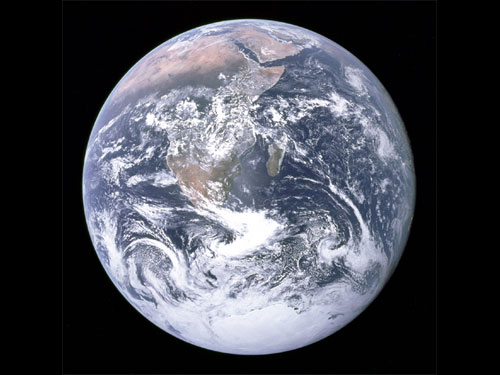
The wealth of understanding about the Earth we have gained from the fleet of spacecraft in orbit around the Earth is priceless. We will continue to design and build spacecraft that help us understand and protect the Blue Marble we call home. That's what we do, and we do a fine job of it.

Wednesday, December 17, 2008

Global Cloud Observation Day - Jan. 13, 2009!

In celebration of its 12th anniversary, NASA’s Students’ Cloud Observations On-Line (S'COOL) Project is declaring Jan. 13, 2009 to be a Global Cloud Observation Day. See
http://asd-www.larc.nasa.gov/SCOOL/Enotes/en_dec2008.html for the latest information.

You can also find a PDF file for a tabloid-sized version of the flyer here:
http://asd-www.larc.nasa.gov/SCOOL/PDF/global_cloud_observation_day.pdf

Tuesday, December 2, 2008

NASA INVITES STUDENTS TO NAME NEW MARS ROVER

Entries Due: Jan. 25, 2009

NASA, in cooperation with Walt Disney Studios Motion Pictures' movie WALL-E from Pixar Animation Studios, will conduct a naming contest for its car-sized Mars Science Laboratory rover that is scheduled for launch in 2009. The contest is open to students 5 to 18 years old who attend a U.S. school and are enrolled in the current academic year. To enter the contest, students will submit essays explaining why their suggested name for the rover should be chosen. In March 2009, the public will have an opportunity to rank nine finalist names via the Internet as additional input for judges to consider during the selection process. NASA will announce the winning rover name in April 2009.

http://marsrovername.jpl.nasa.gov

Monday, November 17, 2008

Aura Spies California Wildfires


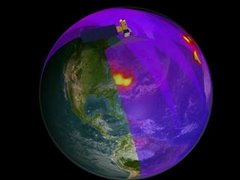
Smoke from the recent outbreak of fires in Southern California can clearly be seen via NASA satellites. On the left, a red-green-blue (RGB) image from the Moderate Resolution Imaging Spectroradiometer (MODIS) on NASA's Aqua satellite shows the smoke being blown to the west from the Los Angeles basin to the waters of the Pacific Ocean on November 16, 2008. On the right, measurements of the Aerosol Index taken by the Ozone Monitoring Instrument (OMI) onboard NASA's Aura satellite are overlayed on top of the MODIS image. As can be seen in this image, the Aerosol Index, which measures the difference in the amount of ultraviolet (UV) light the atmosphere scatters back at given place and time to the amount of UV light that the atmosphere would scatter back if it were totally clear, can effectively detect smoke that is otherwise hard to detect via MODIS imagery as that smoke is transported over bright surfaces such as the low level marine stratocumulus clouds just off the coast. As a result, UV measurements from instruments such as OMI can be used to help detemine the effect such aerosols have on clouds.

MODIS image courtesy the MODIS Rapid Response web site.
OMI AI image courtesy Colin Seftor, NASA Atmospheric Chemistry and Dynamics Branch

Wednesday, November 12, 2008

DIGITAL LEARNING NETWORK HOSTS WORLDWIDE VIRTUAL PARTY FOR NASA

Schools all over the world will wish NASA a happy birthday as part of an all-day virtual birthday party through NASA's Digital Learning Network on Thursday, Nov. 13.

The virtual party begins at 9 a.m. EST with live videoconferences occurring every hour on the hour until 6 p.m. Schools from Canada, Australia, the United Kingdom, Japan, Mexico City, India, Slovenia and New Zealand will participate in the live digital connection.

During each webcast, international schools will connect with a U.S. school and one of NASA's 10 field centers. Each Digital Learning Network site will host a 45-minute videoconference featuring a unique program in NASA's 50 years of discovery and exploration in science, aeronautics and space.

Webcast topics for NASA's 50th birthday party include (all times EST):

- Space shuttle, hosted at NASA's Kennedy Space Center in Florida at 9 a.m.

- Project Mercury, hosted at NASA's Marshall Space Flight Center in Huntsville, Ala., at 10 a.m.

- The Viking Project, hosted at NASA's Langley Research Center in Hampton, Va., at 11 a.m.

- Hubble Space Telescope, hosted at NASA's Goddard Space Flight Center in Greenbelt, Md., at noon.

- Project Gemini, hosted at NASA's Johnson Space Center in Houston at 1 p.m.

- Stennis Space Center history, hosted at NASA's Stennis Space Center in Mississippi at 2 p.m.

- X-43, hosted at NASA's Dryden Flight Research Center in Edwards, Calif., at 3 p.m.

- Icing Tunnel, hosted at NASA's Glenn Research Center in Cleveland at 4 p.m.

- Arc Jet Facility, hosted at NASA's Ames Research Center in Moffett Field, Calif., at 5 p.m.

- Phoenix Mars Lander, hosted at NASA's Jet Propulsion Laboratory in Pasadena, Calif., at 6 p.m.

The birthday party is being held through a partnership among NASA, Discovery Education of Silver Spring, Md., the U.S. Distance Learning Association of Boston and Polycom of Pleasanton, Calif.

NASA's Digital Learning Network began in the spring of 2004 with three hub sites at Langley, Glenn and Johnson and now extends to all 10 field centers. Through interactive videoconferencing, the network allows the next generation of explorers to connect with scientists, engineers and researchers without leaving the classroom. The distance-learning events are designed to educate through demonstrations and live interactions with NASA experts.

To view the live webcasts on Nov. 13, visit:

http://dln.nasa.gov/dln/content/webcast


For more information about NASA's education programs, visit:

www.nasa.gov/education

Thursday, October 2, 2008

Educators to Share MESSENGER's Second Mercury Flyby

On Monday, October 6, 2008, NASA's MESSENGER mission to Mercury will complete an important milestone, as the spacecraft makes its second flyby of its target planet. During the flyby, MESSENGER will swoop just 200 km (125 miles) above the cratered surface of Mercury, snapping hundreds of pictures and collecting a variety of other data from the planet as it gains a critical gravity assist that keeps the probe on track to become the first spacecraft ever to orbit the innermost planet in the Solar System in 2011.

Six MESSENGER Educator Fellows, master science educators talented atspeaking to audiences of all ages and backgrounds, will observe the flyby activities at the Mission Operations Center at the Johns Hopkins University Applied Physics Laboratory and report on their experiences in real time using social networking sites on the Internet. Through the Fellows' eyes, teachers, students, and the general public around the world will be able to share the engineers' excitement as the spacecraft performs a maneuver crucial to the success of the mission, and experience the scientists' exhilaration as new science data never before seen by any human being arrives during the days following the flyby.

Join the MESSENGER Educator Fellows as they report on MESSENGER's second flyby of Mercury by navigating to the Fellows at the Flyby page at: http://btc.montana.edu/messenger/teachers/flyby.php
Follow the links therein to the individual Fellows' Facebook, Twitter, Wiki and blog pages.

The MESSENGER to Mercury mission is supported by the NASA Discovery Program under contract to the Carnegie Institution of Washington and the Johns Hopkins University Applied Physics Laboratory. For more information on the
MESSENGER mission, visit http://messenger.jhuapl.edu/

Thursday, September 25, 2008

Stratospheric Ozone Hole Reaches New Yearly Low


As always, Aura is monitoring stratospheric ozone levels. Yesterday, the "hole" or thinning over Antarctica reached a new low concentration - 106 Dobson units - for 2008.

Each year, ozone levels in the stratosphere drop in the Arctic and Antarctic in their respective winters. Cold temperatures in the atmosphere result in isolation of the air masses above the Arctic and Antarctic circles. This isolation, along with cold temperatures promote chemical reactions that favor the release of a chlorine atom from chemical compounds such as chlorofluorocarbons (CFCs). This Cl atom attaches itself to an oxygen atom and removes it from the ozone molecule. The result is a reduction of ozone in the ozone layer. This process is seasonal - once spring comes around and atmospheric temperatures rise, the isolated air masses return to normal circulation and the chemical reactions that caused the release of chlorine are no longer viable. Ozone levels in the stratosphere then return to normal.

Why are we so interested in stratospheric ozone hole? The ozone in the stratosphere protects all living beings on earth from harmful ultraviolet-c radiation. This uv-c causes the DNA in cells to break down, which can result in cancer. Without the ozone layer, uv-c would be able to penetrate the atmosphere and it would wreak havoc on all living things.

The Aura spacecraft also measures the other chemical players in the reactions that lead to the break down of ozone in the stratosphere in order to better understand how these reactions happen. This understanding can lead to the prevention of the release of chemicals that cause ozone loss into the atmosphere.

Thursday, September 18, 2008

Top NASA Photos of All Time 50 indelible images from the first 50 years of spaceflight

The Smithsonian's Air and Space Museum has published its top 50 NASA photos of all time in honor of NASA's 50th anniversary.

Visitors to: http://www.airspacemag.com/space-exploration/Top_NASA_Photos_of_All_Time.html can view the top 31 images.

The following is from the Air and Space Magazine website.

On the occasion of the 50th anniversary of the National Aeronautics and Space Administration, which began its operations on October 1, 1958, we offer this list of the 50 most memorable images from NASA’s history . We recognize that any such ranking is inherently subjective. The rationale for why any one image ranked two slots higher than any other combines several factors, including our attempt to balance the list between human spaceflight, satellite imaging, and planetary exploration. Many wonderful images did not make the final cut—we couldn’t convince the editors to give us 20 pages instead of 10.

The list omits significant events from space history that were not NASA achievements, such as the famous 1958 photograph of Wernher von Braun and the other architects of the Explorer 1 satellite celebrating their success by holding a model of the satellite over their heads, an event that occurred months before NASA existed. Photos from the Apollo moon program predominate, as well they should—it remains the agency’s crowning achievement. We also recognize that, even though the first “A” in NASA stands for “aeronautics,” our list is light on aeronautical breakthroughs (see Moments & Milestones, p. 84). Our only excuse is that the ranking reflects the affinity of the division of space history staff for space topics. (http://www.airspacemag.com/space-exploration/Top_NASA_Photos_of_All_Time.html)

Tuesday, September 16, 2008

Launch Fest at Goddard Space Flight Center


We are all recovering from Launch Fest, an open house that was held at Goddard Space Flight Center (GSFC) on September 13. According to estimates from our Public Affairs Office, 13,000 people came to see what GSFC is all about! Each of our projects were represented in some way:

  • LRO had exhibits and displays outside of the white room, where the spacecraft was prominently on display
  • Aura had banners and activities that discussed the role of uv radiation in the processes that control the stratospheric ozone hole
  • SAM opened its doors to the Mars atmosphere simulation chamber and showed animations of the Mars Science Lab doing geochemistry on Mars
  • LOLA displayed the engineering model of the instrument along with the heritage instruments MOLA and MLA (aboard MESSENGER), as well as animations of what data from LRO will look like
  • New Horizons had animations of the spacecraft and science results from the Jupiter flyby
Our scientists and engineers did a wonderful job talking about the work they do at GSFC as well as how Goddard contributes to exploration.

Wednesday, August 20, 2008

Astrobiology 2008 - The first music video about Astrobiology

This is a rap video about astrobiology - The search for life in space, particularly on other worlds called exoplanets.

The video has references to:- the origin of life, Genes, DNA and species, Space age, NASA, Lunar Travel, Search for Extraterrestrial Intelligence (SETI)and ET life, Frank Drake, Goldilocks (Habitable) zone, Astronomy, Doppler shift, biology VS mythology,

Friday, August 15, 2008

NASA Edge Visits LRO


NASA Edge heads into the LRO cleanroom
Originally uploaded by geosteph

The team from NASA Edge came to Goddard Space Flight Center on August 14th to prepare for a vodcast on the Lunar Reconnaissance Orbiter. They spent the day over in building 7 - where LRO was built, had it's six instruments integrated, and is now undergoing a series to tests in preparation for a late February launch.

The Edge guys spent time in the LRO cleanroom chatting with folks responsible for integration and testing. They also interviewed several Goddard scientists about the mission.

What a great team! We really enjoyed hosting NASA Edge at Goddard and hope they come back to visit again soon.

Tuesday, July 29, 2008

Check out NASA Images.org


Ever wanted to search through NASA's awesome images in one place? Well, now you can. NASA Images is a service of Internet Archive, a non-profit library, to offer public access to NASA's collections. The goal of NASA Images is to increase our understanding of the Earth, Solar System and Universe in order to benefit humanity. NASA Images will continue to grow with the addition of current media from NASA as well as newly digitized media from the NASA archives.

Users can search through images of the Universe, Solar System, Earth, and astronauts. In addition, you can use a handy time line to search for images by date and missions/programs, all the way from Explorer I in 1959 through current missions to the International Space Station. The image above is the first image of the Earth and Moon in a single frame. It was taken by the Voyager 1 spacecraft in 1977 when it was 7.25 million miles from Earth. Enjoy!!


Friday, July 11, 2008

LRO Update

Ok, I was inspired to write this post because of the picture that was sent out by our Project Manager, Craig Tooley. Let me just get this out of my system - LRO is HOT! Ok. I feel better now.

The picture to the left is of LRO on what is called an Aronson table. The Aronson table enables our engineers to move the spacecraft to different orientations (ie, put the spacecraft on different sides) for testing purposes.


Right now, our spacecraft is undergoing CPT, or Comprehensive Performance Test. This is where we check out all of the systems on the spacecraft while we simulate going through various stages in flight. Our engineers are working around the clock to make sure that everything is functioning properly. You can think of it like doing a practice run before we actually go into space. These tests are critical to working out all the bugs!

LRO has also simultaneously been undergoing the blanketing process. The entire spacecraft needs to be covered in protective material to ensure that it is kept "warm" while in space. The blanket material is the shiny metallic coverings seen on the above photo. The blanketing process is one of the last hardware processes. The last thing that needs to be done to the spacecraft is the installation of the solar array, which is scheduled for Monday, July 14. Once the installation of the solar array is over, LRO will be completely assembled!

Thursday, July 3, 2008

Submit Questions for Lunar Science Conference

The first NASA Lunar Science Conference will be held at NASA Ames Research Center July 20th-23rd. Here is your chance to ask questions via YouTube video..much like the CNN presidential debates! We invite you to join the discussion by submitting a video.

Tuesday, July 1, 2008

Extended Deadline - Send your name to the Moon with LRO!

Have you ever wanted to go to the Moon, but didn't have the money? What about going for free? If you haven't yet signed up to send your name to the Moon, you still have time! Due to overwhelming response from people around the world, we have decided to extend the deadline to send your name to the Moon!

You have until July 25th to send in your name and get your certificate! Don't forget to tell your friends and family too.