Follow LRO at http://lro.gsfc.nasa.gov
Wednesday, November 28, 2007


Tweeting from the LRO Project Science Working Group Meeting
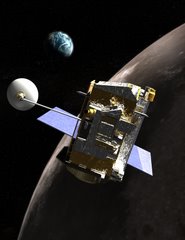
 The Lunar Reconnaissance Orbiter is the first step in NASA's return to the moon. LRO will launch in late 2008 with the objectives to finding safe landing sites, locate potential resources, characterize the radiation environment, and demonstrate new technology. I'm the Education and Public Outreach (EPO) lead for LRO. I'm using twitter to provide updates of the LRO Project Science Working Group (PSWG) that is taking place at Goddard Nov 28-30. You can follow my tweets here or in realtime at twitter.com/geosteph.
Project Manager Craig Tooley is doing the "State of the Project" overview. The current launch date is October 28 2008. Greetings from the Lunar Reconnaissance Orbiter (LRO) Project Science Working Group meeting...live from NASA Goddard Space Flight Center!
Learn more about LRO at http://lro.gsfc.nasa.gov/ check the progress of the spacecraft assembly at http://lro.gsfc.nasa.gov/ha...
Link to instruments http://lro.gsfc.nasa.gov/in... and pics http://www.flickr.com/photo...
Craig just mentioned the Bruce Springsteen road crew tour." I got the most interesting technical questions from this group" during the tour
60 Minutes, BBC, Discovery, WETA, NPR Canada have all been out to capture LRO on film
Next up Joanne Baker with the LRO Orbiter Lever Integration and Test presentation
Joanne is talking about what instrument teams can expect during the integration of their instruments to the spacecraft.
All the instruments be tested before they are integrated...environmental tests ..vibe, thermal vac, acoustics and shock, EMC
new avatar FlatSat - mock up of where instruments go on LRO...in prep for instrument integration
RIck Saylor is discussing the Mission Operations Center--the MOC is where LRO will be commanded and controlled after launch
The LRO MOC is in buidling 32 at Goddard...right next door to my building
The MOC also receives LRO telemetry and data and processed and distributes data to the instrument Science Operations Center-- the SOCs
Stan Scott is now speaking about the LRO Data Working Group. The group includes LRO folks and instrument team members
So, each instrument has a Science Operations Center..that processes it's own data after receiving it from LRO;
Within six months the LRO instrument data is provided to NASA's Planetary Data System (PDS) http://pds/index.html
All NASA Planetary missions are required to deliver data to PDS w/in six months of data acquisition by the instrument teams.LRO instruments CrATER http://lro.gsfc.nasa.gov/cr... - effects of the lunar radiation environment on tissue equivalent plastic
LEND measures the flux of neutrons on the moon..http://lro.gsfc.nasa.gov/le... is the Russian contribution to LROLEND will use neutron flux to determine hydrogen concentration on the lunar surface - looking for possible sources of water
Next up is LOLA..the Lunar Orbiter Laser Altimeter... http://lro.gsfc.nasa.gov/lola.htmlLOLA will make 140 measurements/second. measures range to surface (topography) surface slope, surface reflectance and surface roughness
Reflectance measurements may allow LOLA to "see" water ice in the permanently shadowed regions on the Moon
LOLA PI Dave Smith " ...a negative rock would be a hole" as LOLA 'sees' it
LOLA will do laser ranging-Earth Based laser tracking stations will range to LRO via LOLA for improved LRO timing and orbit determinationThe LRO camera is up now with PI Mark Robinson http://lro.gsfc.nasa.gov/lr..
LROC has a wide angle and narrow angle camera.. LROC's measurement objectives are here: http://lroc.sese.asu.edu/ob.
LROC's narrow angle cameras will give us 25x better image resolution than the current lunar data sets
Diviner will measure lunar surface temperatures at scales that provide information for future surface operations and exploration
Diviner will map global day and night temperatures http://lro.gsfc.nasa.gov/di
LAMP is the Lyman-Alpha Mapping Project http://lro.gsfc.nasa.gov/la... UV from starlight to see in shadowed regions on the MoonThe LAMP instrument is an exact copy of the Alice instrument on New Horizons http://pluto.jhuapl.edu/spa...
The LAMP website has a great summary of the search for water on the moon: http://www.boulder.swri.edu...
Now a talk on the LRO launch window: there are 2 opportunities to go to the moon each day...
Launch window is 2-3 days every two weeks that gives us the optimal lunar orbit
Discussion from LOLA PI Dave Smith about what LRO will do in it's science phase after year 1
LRO's nominal orbit is 50 Km above the lunar surface.
Dave says we will know the topography and gravity field very well after the first year of operations..so we could lower the orbit to 5-10 km
we will find the highest point on the moon when we hit it-eventually LRO will run out of fuel & will have an abrupt landing
Check out the LRO promo http://tinyurl.com/2f8cb9


Monday, November 26, 2007
Lesson: Investigating Seasonal Variation in NO2 Concentrations
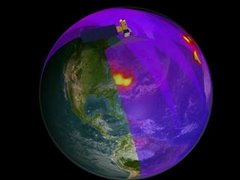
 This lesson was written using Aura data, so that students could use data in their own scientific investigations. Below is an overview of the lesson:
The dataset used in this lesson is monthly averages of NO2 as measured from NASA's EOS Aura spacecraft. NO2 is measured using the Ozone Monitoring Instrument (OMI). OMI is a nadir-pointing instrument that measures trace gases in a column of air directly below the spacecraft. NO2 concentrations are measured in number densities, or the amount of NO2 molecules found in a cubic centimeter of air. Alternately, units of parts per billion can be used, as in the graph at the top of the page. This tells how many NO2 molecules would be found in a sample containing a billion molecules of air. The OMI instrument measures the amount of NO2 in the entire vertical column of air below it, thus the units for OMI measurements are molecules per square centimeter (of the surface).
Purpose: Students will examine data in several formats in order to determine the presence or absence of seasonal variability in tropospheric nitrogen dioxide (NO2) concentrations
For the full lesson plan, please visit the following website:
http://mynasadata.larc.nasa.gov/preview_lesson.php?&passid=59
Wednesday, November 14, 2007
Update on LRO's Assembly

With less than one year to go until launch, the assembly of the Lunar Reconnaissance Orbiter (LRO) spacecraft and its six scientific instruments is in full swing. The actual spacecraft and one of its instruments, the Lunar Orbiter Laser Altimeter (LOLA), are being built here at NASA's Goddard Space Flight Center in MD. Both the spacecraft and all of its instruments must undergo rigorous testing to ensure that they can survive the physical stresses of launch and the extreme environment of space. Each component is exposed to excessive vibrations and extreme hot and cold temperatures in vacuum conditions. In addition, the wiring, electronics, and software is tested and retested to ensure that everything is connected and operating correctly and to ensure the validity of the procedures we'll use to operate the spacecraft and instruments once they're in space. Before we test the actual components that will be traveling into space, we first run the same tests on their mockups! As you can imagine, Goddard engineers and scientists work long and hard to make sure that all of these tests are successful so that the assembly of the spacecraft and its instruments stays on schedule.
Currently, a mockup of the Lunar Exploration Neutron Detector (LEND) instrument is at Goddard to undergo "FlatSat" testing before the actual flight instrument arrives for its own testing next month. "FlatSat" stands for flat satellite and is where all of LRO's electronic components will be laid out and hooked together on a long table and attached electrically like they will be during flight. In addition to testing LRO's components before launch, mission operations will use FlatSat to test commands before sending them to the spacecraft during its actual mission. Click here to see photos of LEND's FlatSat testing and to keep up with other developments in the assembly of LRO.
Subscribe to:
Posts (Atom)